When Anger Becomes a Weapon: What the Karmelo Anthony Case Should Force Us to Ask About Boys and Emotional Regulation
By Kevin George | Clinical Therapist, Former Professional Footballer, Author of Soccology
When Mega Preacher Touré Roberts stepped into the conversation around Karmelo Anthony, the 17-year-old Texas teenager charged with the fatal stabbing of fellow student Austin Metcalf at a high school track meet, the reactions were immediate and divided. Some praised him for centring personal responsibility and emotional self-control. Others felt his biblical framing missed the weight of a life lost and a boy's life now permanently altered. Both reactions contain truth. But neither gets to the root of what I want to address here.
Because beneath the noise of that debate, beneath the race, the politics, and the grief, is a question that I have spent the better part of two decades working on, clinically and in community, with boys and young men in some of the most deprived and dangerous postcodes in this country.

Karmelo Anthony Austin Metcalf Texas Stabbing Teen Violence Emotional Dysregulation
What happens inside a boy's body in the seconds before violence?
The Body Keeps the Score Long Before the Blade Comes Out
Roberts is right that anger does not have to become destruction. He is right that there is a gap between feeling and acting, and that gap is where character lives. What his message doesn't tell us, what no sermon alone can tell us, is how you build that gap when you are seventeen, male, developmentally primed for risk, and nobody has ever shown you how to name what you are feeling.
Emotional regulation is not a personality trait. It is a skill. And like any skill, it requires teaching, modelling, and consistent, safe environments in which to practise it. For many boys, particularly boys who have grown up navigating adversity, instability, or environments where emotional expression was associated with weakness or danger, the nervous system learns a different lesson. It learns that the fastest route out of shame, fear, or humiliation is aggression.
I know this not just clinically. I grew up in south London. I understand viscerally what it means to be a young man in a world where your emotional interior has no language, no container, and no safe audience.
This Is Not a Texas Problem. This Is a London Problem Right Now.
Let's be direct. While the Karmelo Anthony case has dominated screens in America, we do not need to look across the Atlantic to find the consequences of unregulated emotion in young men.
In London, knife crime remains one of the most pressing public health crises of our time. The majority of those who carry, and those who are harmed, are young males. Many are teenagers. Most will have had no access to meaningful therapeutic support. Many will have experienced trauma, loss, fractured attachment, school exclusion, and the constant background hum of hypervigilance that comes with growing up in environments where threat can feel omnipresent.
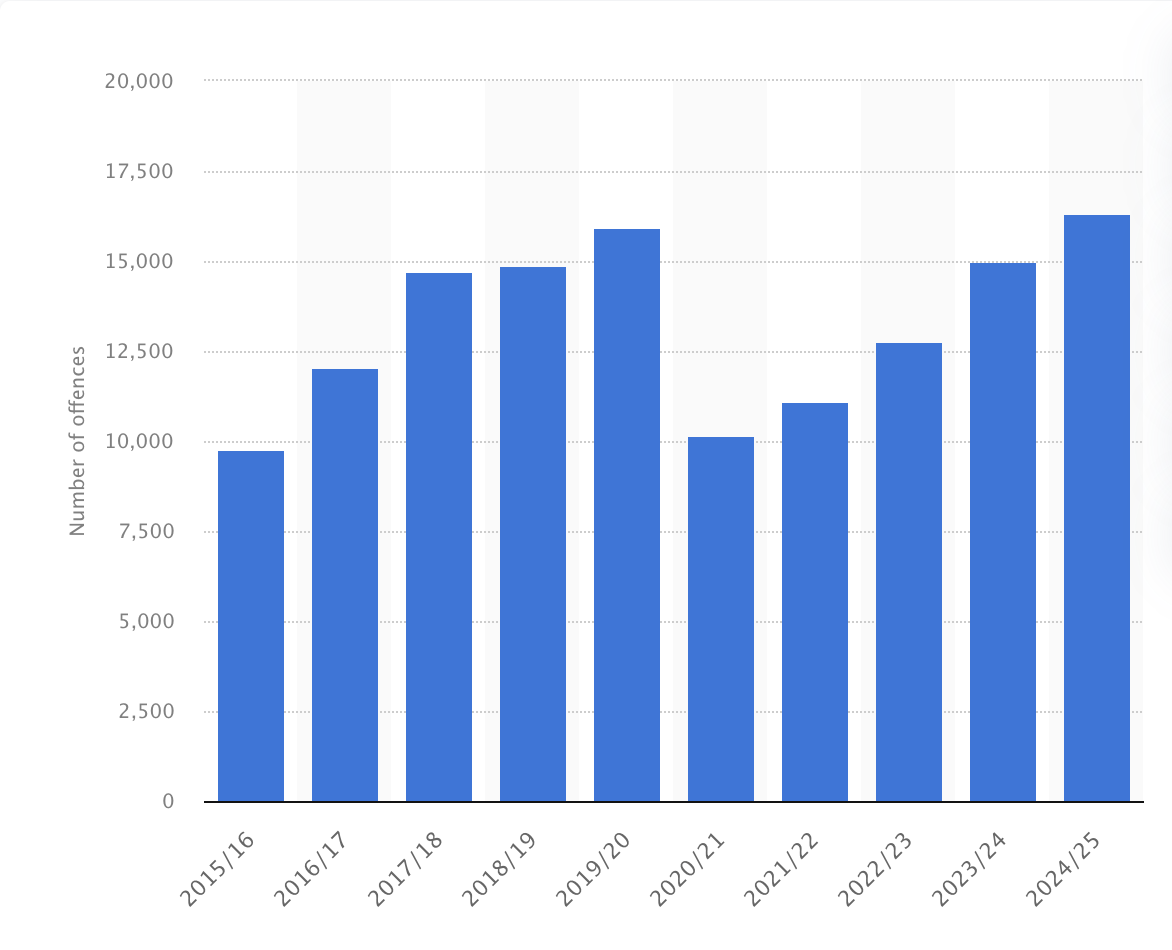
Number of police recorded knife or sharp instrument offences in London from 2015/16 to 2024/25
The same dynamics that place a boy in Texas at a track meet holding a knife exist in a boy in Peckham, Tottenham, or Lewisham holding one. The geography changes. The internal architecture of unprocessed emotion, dysregulated arousal, and identity threat does not.
Stabbing is rarely, almost never, a considered act. It is a window of dysregulation. It is the body making a split-second decision when the thinking brain has already gone offline. It is the amygdala, not the prefrontal cortex, in charge. And we do not solve an amygdala problem with a sermon. We do not solve it with a court sentence alone. We solve it by intervening upstream, long before that moment arrives.
What Emotional Regulation for Boys Actually Requires
In my clinical practice as a BACP-registered therapist, and through my work as Head of Health and Wellbeing in a specialist SEND school, I work daily with young people whose emotional worlds are chaotic, unnamed, and uncontained. I also work as a Senior Family Therapist in Private Law, and as Director and Lead Clinician of Soccology, where we use football as a therapeutic entry point for boys and young men who would never walk through a counselling door.
What I have learned across all of these settings is this: boys do not need to be lectured about anger. They need to be understood in it.
Effective emotional regulation work with boys and young men must do several things simultaneously:
It must meet them where they are. For the majority of boys at risk, particularly Black boys, working-class boys, and SEND boys, traditional talking therapy is not the entry point. Culture is. Football is. Music is. The barbershop is. The things they already trust. Through Soccology, our football-entry model produces a 30% self-referral rate from participants into deeper therapeutic support. That is not a coincidence. That is what happens when you build a containing environment before you ask someone to be vulnerable.
It must work at the level of the body, not just the mind. Emotional regulation is somatic before it is cognitive. A boy who has been living in fight-or-flight for years needs co-regulation, a calm, consistent, present adult body, before he can access the reflective thinking that words require. This is why relational therapy, when applied well, is transformative. It is also why punitive exclusion from school, which removes a boy from the very relational environment in which repair might occur, is so deeply counterproductive.
It must address identity, not just behaviour. One of the frameworks I return to repeatedly in my clinical and public-facing work is what I call identity inversion, the process by which boys, particularly those who have been excluded, criminalised, or failed by institutions, begin to build their sense of self around the very things that put them at risk. Violence becomes currency. Toughness becomes identity. This is not moral failing. It is adaptive. It is the self doing the only thing available to it in the absence of better options.
Repair requires identity work. It requires giving a boy a new narrative about who he is and who he can become.
It must include fathers. Often in my work I target what I call "Invisible fathers”, men disengaged from their children's lives not by indifference but by the structural and emotional barriers that prevent engagement. We have seen how paternal presence, when properly supported, is one of the most powerful protective factors available. A boy who has a regulated man in his life has a template. He has a mirror. He has permission to be something other than what the street tells him to be.
The Gap Between a Sermon and a System
I respect Touré Roberts' intention. The message that we can be angry without becoming destructive is true, important, and, if received well, potentially life-altering. But intent requires infrastructure. A sermon without a system changes individual hearts. A system without heart changes nothing at all. What we need is both.
We need school-based therapeutic provision that doesn't wait for a crisis to intervene. We need commissioned football and community programmes, not as box-ticking exercises, but as genuine clinical entry points. We need family court systems that centre children's wellbeing over legal attrition. We need health commissioners brave enough to fund what the evidence actually supports, not just what fits neatly into a referral pathway.
And we need more people willing to stand in the gap between a boy's breaking point and the moment the system criminalises him for it.
That is the work I do every day. Through individual therapy, through Soccology, through keynote speaking, through consultancy, and through a book — Soccology, British Library archived, Amazon No.1 bestseller. that puts the internal world of a young man on the page in language that doesn't require a clinical dictionary to understand.
If You Are Working With Boys, I Want to Work With You
Whether you are a school leader, a commissioner, a parent, a coach, or a professional working in the youth sector, the conversation Touré Roberts opened, however imperfectly, is the right one. Emotional regulation for boys is not a soft issue. It is a public health issue. It is a knife crime issue. It is a life or death issue.
I offer:
Individual therapy for boys, young men, and families, in London and nationally online via kevingeorge.online and Psychology Today
Consultancy and training for schools and organisations on trauma-informed practice, safeguarding, and SEND-aware therapeutic provision
Keynote speaking on performance psychology, emotional literacy, identity, and the intersection of football and mental health
Soccology programmes, football-as-therapy delivery for boys and young men at risk, through Soccology CIC
If a boy in your life, your school, or your community is struggling with anger, with identity, with the weight of a world that has given him no tools to carry it, reach out.
The gap between a feeling and a weapon is where we do our work.
Kevin George is a BACP-registered psychotherapist, Senior Family Therapist, Head of Health and Wellbeing and Designated Safeguarding Lead at RISE Education, and Director of Soccology CIC. He is the Amazon No.1 bestselling author of Soccology (archived in the British Library). He is a former professional footballer (West Ham United, Charlton Athletic) and a regular expert media contributor on performance psychology, emotional literacy, and youth wellbeing.
Connect: kevingeorge.online | Instagram: @iamkevingeorge
Frequently Asked Questions (FAQ)
What is the Karmelo Anthony case and why does it matter beyond the verdict?
Karmelo Anthony is a teenager from Texas who was convicted of murder and sentenced to 35 years in prison in June 2026 following the fatal stabbing of Austin Metcalf, a 17-year-old student athlete, during a high school track meet in April 2025. The confrontation began over seating arrangements. Anthony's defence team argued he acted in self-defence and asked the jury to consider the legal concept of "sudden passion," meaning he acted directly out of an overwhelming emotional response before having time to calm down. The jury rejected it.
The case matters beyond the verdict because it forces an urgent question that the legal outcome cannot answer: what happens in the gap between a feeling and a fatal act, and who is responsible for teaching young people, particularly young boys, how to close that gap? That is a question for clinicians, educators, parents, and policymakers, not just courts.
What is emotional regulation and why do boys and young men struggle with it?
Emotional regulation is the capacity to identify, understand, and manage emotional responses, particularly under pressure. It is not the absence of emotion. It is the ability to feel something intensely and still make a considered choice about what to do with it.
The adolescent brain is still developing the regions responsible for impulse control, risk assessment, and long-term decision-making, while emotional and reward systems mature earlier. This creates a developmental window in which young people are physiologically more vulnerable to emotionally charged decision-making in high-conflict situations. For boys, this neurological reality is compounded by a social script that actively discourages emotional expression. Boys are taught that strength means containment, that vulnerability is weakness, and that anger is the one emotion that is culturally permissible. When you remove every outlet except anger, anger becomes the only language available. And that is a dangerous language to be fluent in without knowing how to write in anything else.
I explore this in depth in Are We Letting Boys and Men Down? Rethinking Mental Health Support Beyond Talk Therapy, where I argue that the standard mental health offer for boys and young men is not designed for the way they actually process and express distress.
Is the Karmelo Anthony case a race issue or an emotional regulation issue?
It is both, and the refusal to hold both simultaneously is itself part of the problem.
Race shapes the context in which Black boys are raised, the institutions they navigate, the assumptions that are made about their anger, and the leniency or severity with which that anger is judged by systems of authority. It also shapes which young men receive investment in their emotional development and which do not. To discuss emotional regulation without race is to discuss a symptom without its environment.
At the same time, reducing the case entirely to race risks missing the clinical and developmental questions that apply across all boys regardless of background: what are we teaching young men about anger, about conflict, about the distance between feeling and action? The fact that the racial dimensions of this case are real does not exempt us from asking those questions. It makes them more urgent.
What is the difference between anger and violence, and how do we teach boys to understand that difference?
Anger is a healthy, neurologically normal response to perceived threat, injustice, humiliation, or loss. It is not the problem. The problem is when anger has nowhere to go except outward and immediately, because nobody has ever given a young person the language, the tools, or the relational safety to process it any other way.
Violence is what happens when anger meets an absence of alternatives. It is rarely random. It is almost always the endpoint of a developmental journey in which emotional literacy was never offered, modelled, or treated as important.
Teaching boys the difference requires something more than conflict resolution programmes or classroom-based social skills curricula. It requires adults who model emotional honesty, institutional cultures that make it safe for boys to name what they are feeling without being ridiculed, and consistent, sustained relational investment that cannot be delivered in a one-off intervention. This is the work I carry through Soccology CIC, through my education wellbeing practice, and through the Street Health programme, which uses music and community to reach boys who have been written off by traditional services.
What is emotional literacy and how is it different from emotional intelligence?
Emotional intelligence is a broad concept describing the capacity to recognise, understand, and manage emotions in yourself and others. Emotional literacy is more specific and more foundational: it is the ability to name what you are feeling, to locate it in your body, to understand where it has come from, and to communicate it in a way that does not cause harm to yourself or others.
You cannot regulate what you cannot name. A boy who has never been given the vocabulary or the permission to say "I felt humiliated and that triggered fear" will not be able to process that experience in real time under pressure. He will feel something enormous, he will have no frame for it, and he will act. The gap between that feeling and that action is where emotional literacy lives, and where the intervention needs to happen long before any crisis point.
I set out the full clinical case for emotional literacy as a public health and educational priority in Emotional Literacy: The Key to Personal Growth and Mental Wellbeing.
Why do we keep responding to these cases with punishment rather than prevention?
Because punishment is visible and prevention is not. A court case, a sentence, a verdict: these produce a legible narrative of consequence. The long-term investment in emotional development that might have intervened years earlier produces nothing that photographs well or lands in a headline.
There is also a political and cultural reluctance to extend empathy toward young men, and particularly toward young Black men, who transgress violently. The empathy is easier to generate for younger children. By the time a boy is a teenager and his anger becomes dangerous rather than merely difficult, the cultural patience for his emotional history has often run out entirely.
I wrote about this dynamic in Even Gangsters Tried the Moonwalk: Reaching Vulnerable Boys Through Sport, Art and Mentorship, and it is central to why I designed Soccology CIC and Street Health as outreach-first rather than referral-dependent models. Boys who need the most investment are the ones most likely to be excluded from the institutions designed to provide it.
What role does school play in emotional regulation development, and what happens when it fails?
School is, for most young people, the primary institution outside the family in which emotional patterns are shaped. When schools invest in emotional literacy, in restorative practice, in staff who are trained to recognise distress rather than simply manage behaviour, they become protective environments that extend a young person's capacity to regulate under pressure.
When schools fail in this, whether through inadequate training, exclusion-first discipline policies, or an institutional culture that treats emotional difficulty as a behavioural problem to be removed rather than a developmental need to be addressed, they become environments that confirm a young person's worst beliefs about themselves and about authority. They teach that feelings are inconvenient, that help is conditional, and that the only safe strategy is suppression.
In my work across specialist SEND education, family therapy, and community health, I see the downstream consequences of those failures every day. The young person sitting in a family court hearing or a youth offending panel is almost always someone whose emotional development was neglected by multiple institutions across multiple years. The Karmelo Anthony case is a reminder that those failures eventually produce outcomes that no one wanted and that everyone then struggles to explain.
What should parents be doing differently when it comes to boys and anger?
The most important thing is to stop treating anger as the enemy. Parents who respond to a boy's anger with punishment, withdrawal, or contempt teach him that the feeling itself is dangerous, and that the safest thing is to hide it. Hidden anger does not disappear. It accumulates.
Instead, parents can name emotions openly and model the process of working through them. They can ask questions that invite a boy to locate his experience: not "what happened" but "what did that feel like." They can hold boundaries around behaviour while still holding empathy for the feeling behind it. And they can resist the cultural pressure to raise boys who are stoic rather than self-aware, because stoicism without self-awareness is not resilience. It is suppression with a more acceptable name.
What does the Karmelo Anthony case ask of clinicians and mental health professionals?
It asks us to be honest about the gap between what our services are designed to offer and what young men, particularly young men from communities with high levels of systemic disadvantage, actually need and will actually engage with.
Standard talking therapy, delivered in a clinic room by appointment, with a waiting list, in professional language, is not the first-access point for the majority of young men who carry the level of unprocessed emotional material that produces violent outcomes. That is not a criticism of the therapy. It is a description of the access problem.
The clinical question the case forces is: how do we get to young people before the crisis, in the settings where they actually are, using the languages they actually speak? This is why my work increasingly centres community-based, outreach-first, culturally embedded models. If the young man will not come to us, we have to go to where he is. My therapy and clinical services operate on this principle, and it underpins everything I build through Soccology CIC and the Street Health programme.
How can I access support around emotional regulation, adolescent mental health, or boys' wellbeing?
If you are a parent, educator, or professional navigating these questions, or if you are a young person looking for support, I offer a range of clinical, educational, and community-based services through kevingeorge.online. This includes individual therapy, clinical supervision, organisational consultancy, and keynote delivery on boys' mental health, emotional literacy, and community wellbeing. You can also explore the full blog archive for free resources grounded in clinical practice and lived experience. Get in touch directly and all enquiries are responded to within 48 hours.