
PUBLISHED WORK
Published writing by therapist Kevin George on mental health, emotional literacy and football psychology.
Kevin George's published work spans professional sport, mental health, education, and cultural identity. Across books, articles, and research contributions, a single thread runs through everything: the belief that mental and emotional wellbeing can be made accessible to people who have historically been excluded from the conversation. This page brings together that body of work in full.
No Place For Me: Stories About the Windrush Generation
Kevin George is one of twelve authors contributing to this full-colour anthology exploring the lives, sacrifices, and resilience of the Windrush generation. The collection, edited by Dame Floella Benjamin, was created from first-hand accounts and draws on the lived histories of people who shaped modern Britain.
The anthology reflects Kevin's longstanding commitment to cultural identity, community, and the stories that are too often left untold. Fifty pence from every copy sold goes directly to the Black Cultural Archives, the only national heritage centre dedicated to collecting, preserving, and celebrating the histories of Black people in Britain.
‘No Place For Me’ available from Amazon, Foyles and Waterstones.

Featured Articles and Expert Contributions
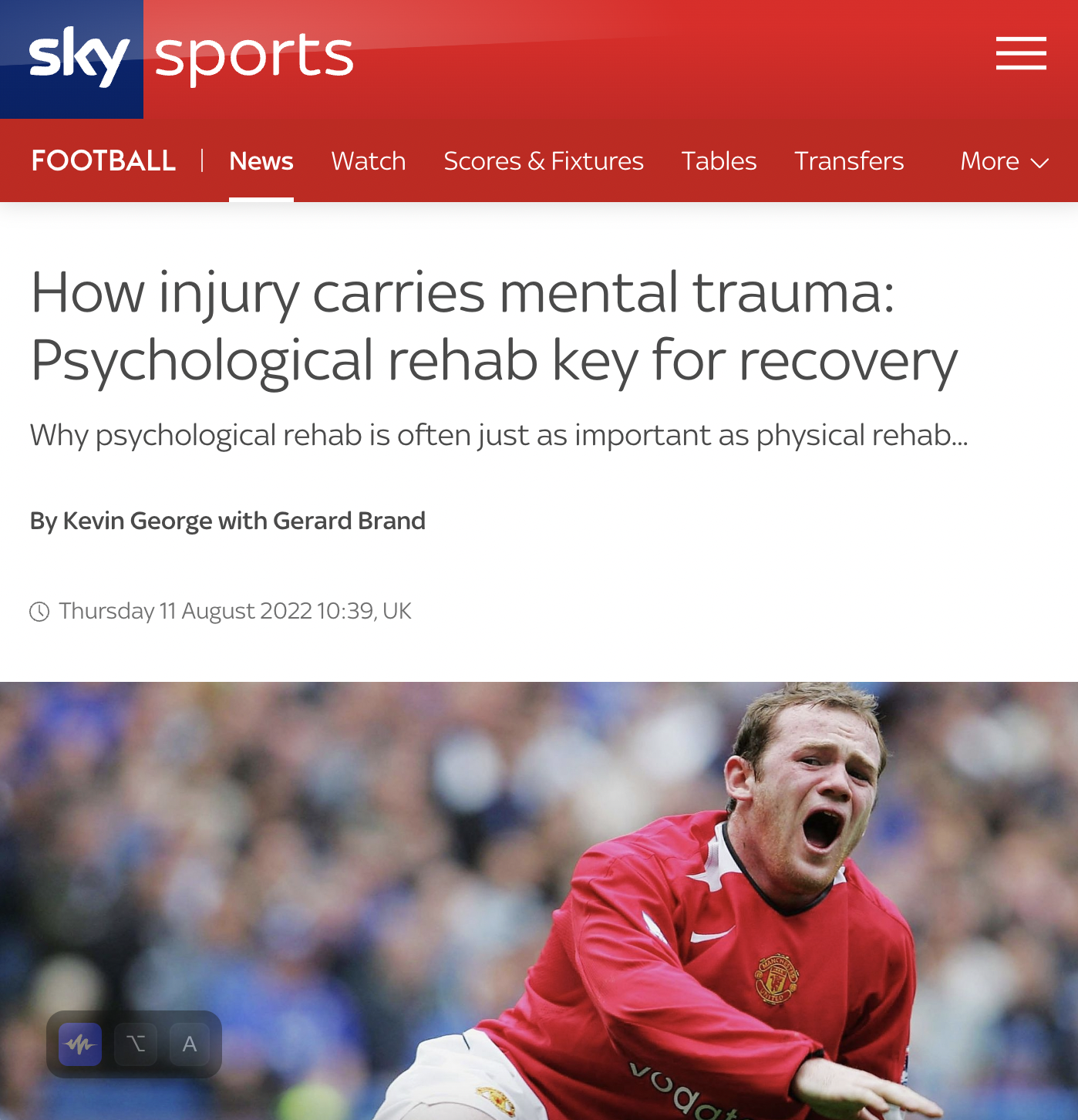
How Injury Carries Mental Trauma: Psychological Rehab Key for Recovery
Published by Sky Sports, this article examines a dimension of sports injury that is consistently overlooked: the psychological cost. Drawing on his clinical practice and experience as a former professional footballer, Kevin explores how injury does not just damage the body. It disrupts identity, creates prolonged anxiety, and fundamentally changes the way an athlete understands themselves in relation to their sport.
Kevin argues that recovery must be understood as a dual process, addressing both the physical and the psychological dimensions simultaneously. Without mental and emotional rehabilitation, athletes return to play carrying unresolved distress that affects performance, relationships within the team, and long-term psychological health. The article sets out what genuinely effective recovery support looks like and why most clubs still fall short of providing it.
Read the full article at Sky Sports
Non-Verbal Communication in Teaching and Leadership
Published by the British Council in their International Education Magazine, this article makes the evidence-based case for understanding non-verbal communication as the primary medium through which educators and leaders actually influence the people around them.
Drawing on research showing that only 7 percent of communication is verbal, with body language accounting for 55 percent and tone of voice for 38 percent, Kevin explores how movement, posture, eye contact, facial expression, and spatial positioning all function as communication signals that reinforce or undermine spoken content. The article introduces the concept of spatial staging, the deliberate use of physical positioning to signal shifts in tone, focus, and authority, and argues that developing awareness of non-verbal habits is one of the highest-return investments any educator or leader can make.
Kevin includes practical techniques for developing greater non-verbal awareness and suggests video feedback as a concrete tool for building authenticity in professional communication.
Read the full article at the British Council website.

Football and Mental Health: Investigating What Goes On Inside the Heads of the Game's Best
Published by GQ in May 2018, this article established Kevin George as one of the first clinicians with direct professional football experience to bring the psychology of the game to a mainstream male audience. Written under his byline as Mr Soccology, it drew on 16 months of original research and interviews with some of the biggest players, managers, and coaches in world football.
At the heart of the piece is a clinical insight that runs through all of Kevin's work: that the psychological demands of professional football are systemic, not individual. Acceptance and rejection, belonging and exclusion, the need for approval from teammates, coaches, and fans are not personal weaknesses in individual players. They are the structural conditions of the game itself.
Two major interview subjects anchor the argument. Anthony Gardner describes how feeling valued at Hull City transformed his performance without any tactical change. Fabian Delph speaks about the psychological cost of injury and the absence of any framework within football for helping players manage it. Gaël Clichy documents how his meditation practice directly influenced his performance in a Champions League match against Barcelona.
Kevin closes by shifting the conversation from illness to health, arguing that preventing psychological harm in football matters as much as treating it. The piece is significant not just as a media credential but as evidence that Kevin was making this argument to a global male audience before most of the sport had caught up.
Read the full article at gq-magazine.co.uk.

Books
Soccology: Inside the Hearts and Minds of Successful Professionals
Soccology is Kevin George's landmark work exploring the psychological and emotional demands of professional football. The book draws on over 100 hours of original research, including in-depth interviews with 45 professional footballers, 3 professional coaches, a senior partner from KPMG, and a psychophysicist from the University of Montreal.
Kevin George's published work spans professional sport, mental health, education, and cultural identity. Across books, articles, and research contributions, a single thread runs through everything: the belief that mental and emotional wellbeing can be made accessible to people who have historically been excluded from the conversation. This page brings together that body of work in full.
The research spans the full breadth of the professional game, covering topics including state of mind and mental architecture, the competence cycle and peak performance, leadership and club culture, identity and life after football, mental health stigma within the sport, and the emotional cost of a career played out under constant public scrutiny.
Soccology does not deal in clichés or easy answers. It goes inside the experience of professional football with clinical precision and genuine cultural fluency, and uses the language of the game to bring men into honest conversations about their inner lives. For many of the players interviewed, it was the first time they had spoken openly about their psychological experience of the sport.
The book became an Amazon No.1 bestseller. Its publishing rights were sold internationally, with a Korean edition available. It is preserved in the British Library vault as part of the UK's literary heritage.
Soccology is available for purchase at OWN IT!, Amazon, Foyles and Waterstones.
His research for the book involved conducting over 100 hours of interviews with 45 professional footballers, 3 professional coaches, 1 psychophysicist from the University of Montreal, and 1 senior partner from KPMG.

(FAQ) Frequently asked questions about Kevin George’s research and published work
What has Kevin George published?
Kevin George has published Soccology: Inside the Hearts and Minds of Successful Professionals, an Amazon No.1 bestseller, and contributed to No Place For Me, an anthology about the Windrush generation. He has also published expert articles with Sky Sports, British Council and GQ.
What is Soccology about?
Soccology is a book by Kevin George exploring the psychology of professional football through over 100 hours of original interviews with 45 professional players, 3 coaches, a KPMG senior partner, and a University of Montreal psychophysicist. It examines the mental, emotional, and cultural demands of the game.
Where can I buy Soccology by Kevin George?
Soccology by Kevin George is available from Amazon, Waterstones, Foyles, and OWN IT London. A Korean edition is also available internationally.
Has Kevin George written for Sky Sports?
Yes. Kevin George has contributed expert clinical analysis to Sky Sports, including a widely read article on the psychological impact of sports injury and the case for mental health rehabilitation in athlete recovery.