What a Bollywood Film Set Taught Me About Rest, Presence, and the Art of Slowing Down
Published on kevingeorge.online | Kevin George | Clinical Therapist, Author, Former Professional Footballer
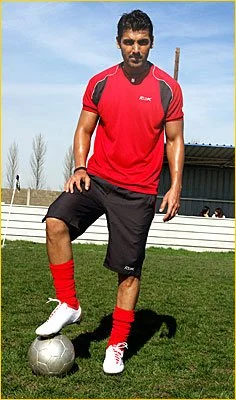
On the set of the Bollywood film Goal (2007) with John Abraham, where an encounter with a fellow actor first introduced me to the life-changing practice of tai chi and qi gong.
There is a particular kind of stillness that has nothing to do with being still. I did not understand that until the summer I spent on the set of the Bollywood film Goal, working as a body double for John Abraham.
I was a professional footballer. I had played for West Ham United and Charlton Athletic. My body was what I used. I understood physical discipline, training loads, recovery protocols, the machinery of performance. What I did not understand, not really, was rest.
That changed when I met an actor on set who changed the frame entirely.
The Man on the Film Set
He was quiet in a way that was not passive. He had the speed and the power of someone who had been training for decades, and he had. His background was in kung fu. But what stopped me, what genuinely stopped me, was watching him move through tai chi and qi gong sequences between takes.
There was no performance in it. No exhibition. He moved as if the movement was the point, not a means to any other end. His calm was not the calm of someone who had nothing happening inside. It was the calm of someone who had learned to organise what was happening inside.
I asked him about it. Not many words came back. What he said stayed with me: that these arts are a conversation between the body, the mind, and the present moment. And that most people never show up to that conversation at all.
By the time filming ended that summer, I had enrolled in both tai chi and qi gong.
What I Thought Rest Was
Before tai chi, I thought rest meant sitting down or lying down. That was the definition I was operating with. You stop moving, you rest.
What I did not account for was this: a mind that does not stop. A nervous system that stays in resource-consuming overdrive regardless of whether the body is horizontal. The sitting-down version of me was still processing, still planning, still half-answering emails I had not yet opened, still rehearsing conversations that had not happened, still somewhere other than where I was.
That is not rest. That is fatigue in a chair.
Tai chi and qi gong introduced me to something different. The movements are slow and deliberate and they demand something that turned out to be extraordinarily difficult: your full and undivided attention, right now, to what your body is actually doing.
My Teacher Did Not Speak
My tai chi teacher had a particular approach to instruction. He did not speak to us. He would make this clear from the beginning: his communication was non-verbal, and our responsibility was to pay attention.
Initially, I found this genuinely frustrating. I was used to explicit instruction. I was used to being told what to do and correcting accordingly. The silence felt like an absence of teaching.
What I slowly understood was that the silence was the teaching.
The movements in tai chi are simple enough that a busy brain will dismiss them. That is the trap. My mind, trained by years of professional sport and later by the demands of clinical practice and academic study, would observe a movement, decide it had registered it, and immediately drift. I wonder if I sent that email to Mark. Did I confirm Thursday's session? What is the structural argument I want to make in chapter four?
And while my mind was somewhere else entirely, I was missing something. My teacher's thumb was arched as he transitioned between positions. Mine was straight. Now we were doing different things. The gap between us was invisible to anyone watching casually and vast to anyone watching closely.
The details matter. They always matter. The slowness of the practice is not an absence of difficulty. It is where the difficulty lives.
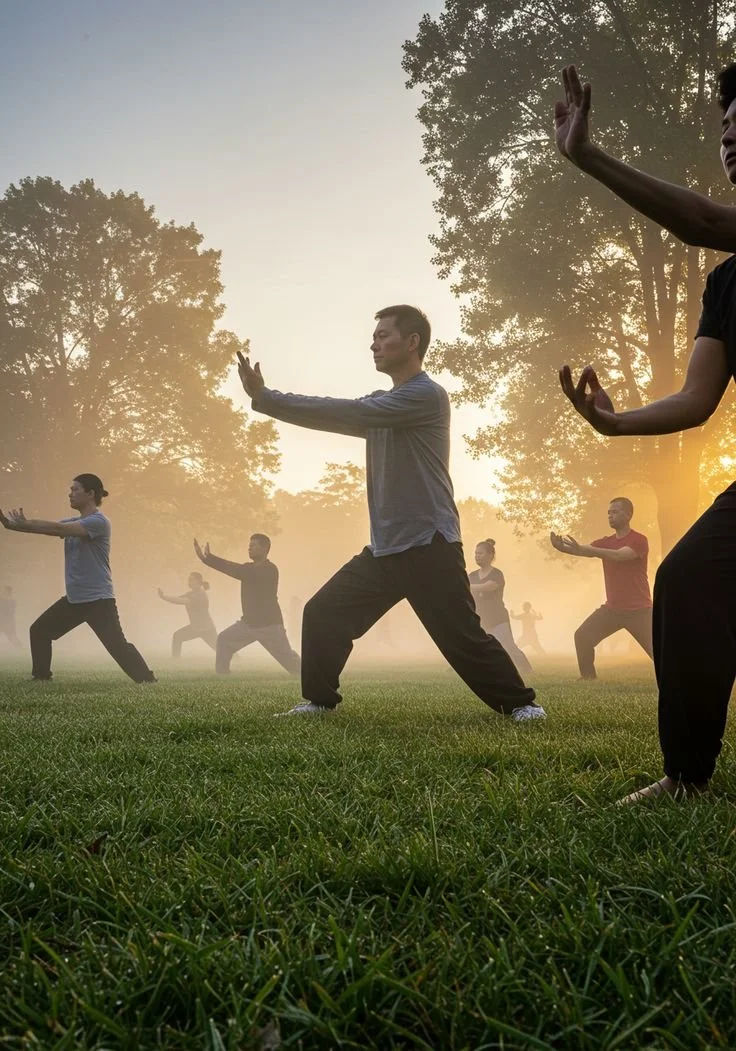
The slow, deliberate movements of tai chi and qi gong produce a depth of rest that sitting still cannot replicate for an overactive nervous system.
What These Practices Gave Me
The most direct gift was a recalibration of what rest actually means. Rest is the nervous system being genuinely off-duty. Rest is the mind inhabiting the present moment without the background hum of unfinished business. I had not experienced that consistently before tai chi. I experience it now.
But the less obvious gift, and the one that has shaped my clinical work most profoundly, is attunement.
Tai chi trains you to be present to the smallest details: the positioning of a thumb, the weight distribution across a foot, the particular quality of someone's stillness. That quality of attention, slow, non-reactive, non-judgemental, continuously present, turns out to be exactly what effective therapeutic work requires.
This has been particularly significant in the environments where I work with boys.
What the Boys Already Know
When I work with young people who are carrying high levels of trauma, in SEND schools, alternative provisions, youth offending institutes, and prisons, there is a dynamic I encounter consistently. These boys will present the worst version of themselves first. They do it deliberately and they do it early. They want to know whether you will manage it, judge them, reject them, or stay. They have learned through experience that the answer is usually some version of leaving.
The other young people in the room are watching this unfold. The level of hypervigilance in those spaces is acute in a way that is difficult to overstate. They are reading you at a level of precision that I would compare to inspecting the gait of a bee hummingbird. Nothing escapes them. The micro-expression you do not know you have. The slight shift in your posture when something surprises you. The moment your presence wavers because something landed that you were not expecting.
They describe the workers who came before you as corpses. People who were physically present and functionally absent. People who could be rattled. People who could not hold the room because they could not hold themselves.
Tai chi gave me a quality of regulated presence that is not performed. You cannot perform this. Young people with complex trauma will see through a performance immediately. What they respond to is something more fundamental: the felt sense that you are genuinely here, that you are not frightened of what they are bringing, and that you are not going anywhere.
That quality of presence is not natural to me. I developed it. Part of how I developed it was standing in a room, in silence, concentrating my attention to the present moment.
The Moving Meditation and Mental Health
There is a growing body of evidence that tai chi and qi gong produce measurable benefits for mental health: reduced anxiety, improved sleep quality, lower cortisol levels, enhanced emotional regulation, and greater resilience to stress. For anyone working in the wellbeing field, or anyone supporting young people or families through difficulty, that evidence is worth taking seriously.
But beyond the research, my experience of these practices is more personal and more specific. They taught me that the quality of your attention is a skill that can be trained. They taught me that rest is something you have to learn, not something that simply happens when you stop. They taught me that presence is the foundation of everything else, clinically and personally.
A Bollywood film set was not where I expected to learn any of that. But that is usually how it goes. The most important lessons do not announce themselves. You have to be paying attention to details as small as your thumb.
Frequently Asked Questions (FAQ)
What is the difference between tai chi and qi gong? Both are rooted in Chinese movement traditions and work with the flow of energy through the body. Qi gong tends to consist of repeated, specific movements or breathing exercises designed to cultivate energy in particular ways. Tai chi is a broader practice rooted in martial arts, typically performed as a flowing sequence of movements that build on one another. In practice they overlap considerably, and many teachers and practitioners engage with both.
Do you need to be physically fit to begin tai chi or qi gong? No. These practices are suitable for almost all fitness levels and ages. The movements are gentle, low-impact, and adaptable. Many people are drawn to them precisely because they offer profound physical and mental benefit without the intensity of conventional exercise.
Can tai chi and qi gong help with anxiety and stress? There is substantial research supporting their effectiveness for anxiety reduction, stress regulation, and improved sleep. More importantly, they train the nervous system toward a state of genuine rest rather than suppressed arousal, which is where many conventional relaxation approaches fall short for people with overactive minds or dysregulated nervous systems.
How long did it take before you experienced the benefits? The honest answer is that the benefits built gradually and I did not always recognise them as they were happening. The restlessness I felt early in practice, the frustration with the simplicity, the drifting mind, those are not failures. They are the practice. The point at which I began to notice a difference in my quality of rest and my quality of presence was several months in, and the development has continued across years.
Is this relevant to therapeutic practice? I would say it is foundational to mine. Regulated therapeutic presence, the ability to remain genuinely calm and attentive in the face of distress, volatility, and complexity, is not a default setting for most people. It is a capacity that needs to be developed and maintained. Tai chi and qi gong have been among the most effective tools I have found for doing that.
How do these practices apply when working with traumatised young people? Young people carrying significant trauma, particularly those in alternative provisions, youth offending institutes, or secure settings, are extraordinarily skilled at reading the adults around them. Their survival has often depended on it. The quality of your presence, your capacity to remain regulated, non-reactive, and genuinely available, is what determines whether they can begin to trust. Tai chi and qi gong have trained that quality in me more effectively than any other practice I have encountered.
Kevin George is a BACP-registered psychotherapist, Senior Family Therapist, and former professional footballer. He is the founder of Soccology CIC and author of the Amazon No.1 bestseller Soccology. He works across clinical, community, and elite sport settings, including SEND schools, youth offending institutes, and Premier League academies. He writes at kevingeorge.online.