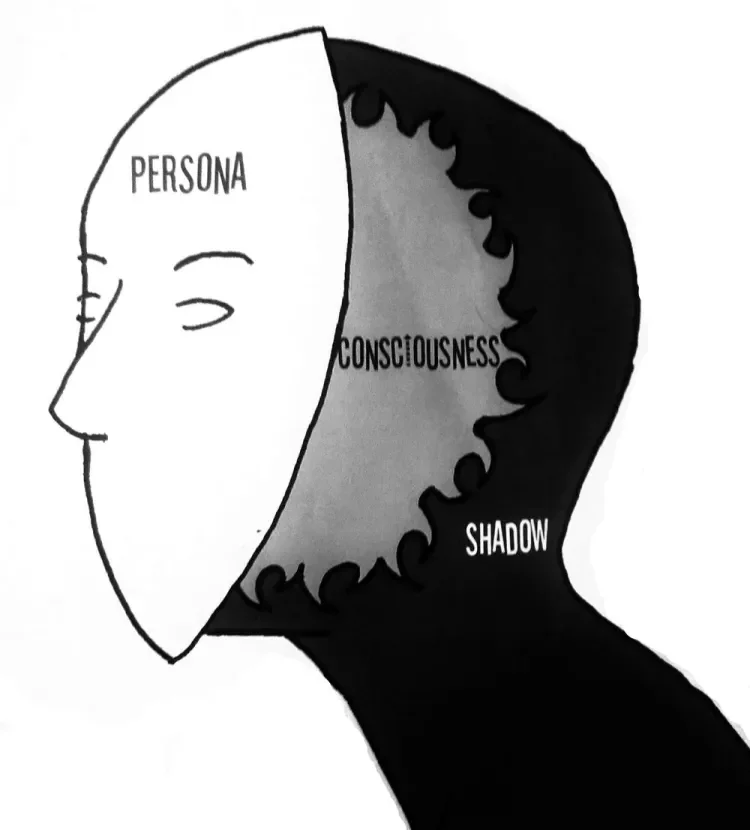
The World of Self: How Creative Expression Supports Mental Health in SEND Schools
By Kevin George | Clinical Therapist, Former Professional Footballer, Author of Soccology
I worked with a group of SEND students who experienced significant challenges with reading social cues, expressing themselves, and engaging with abstract thinking, patterns often associated with ADHD and autism. Their biographies carried an extra layer of complexity. Navigating a world not always designed for how they experience it added another challenge on top of the two parallel realities neurotypical people struggle to manage.
So last year, I created an art exhibition for them to create art pieces that promoted interoception. Allowing their peers, families, social care workers and school staff to step, however briefly, into their lived experience. It was an attempt to make the invisible visible, to translate internal worlds into something others could feel. A space where there is not one shared map, but only one set of footprints, belonging to the person already navigating a world others are still trying to understand.
Eight pages. A south London school floor. A poem about the two worlds we all live in, and learning about the one that is entirely your own.
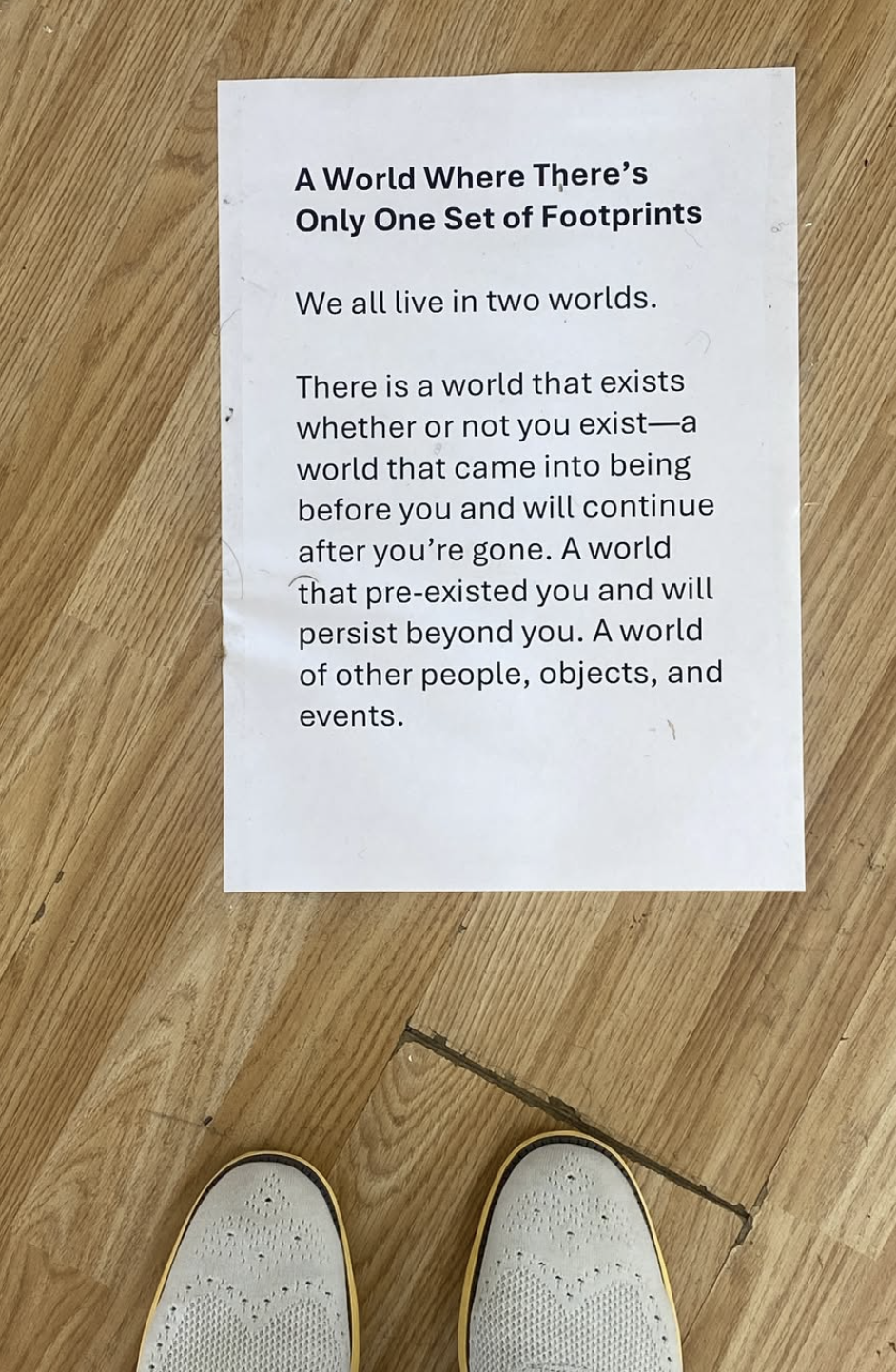
Two Worlds, The Opening of A World Where There's Only One Set of Footprints
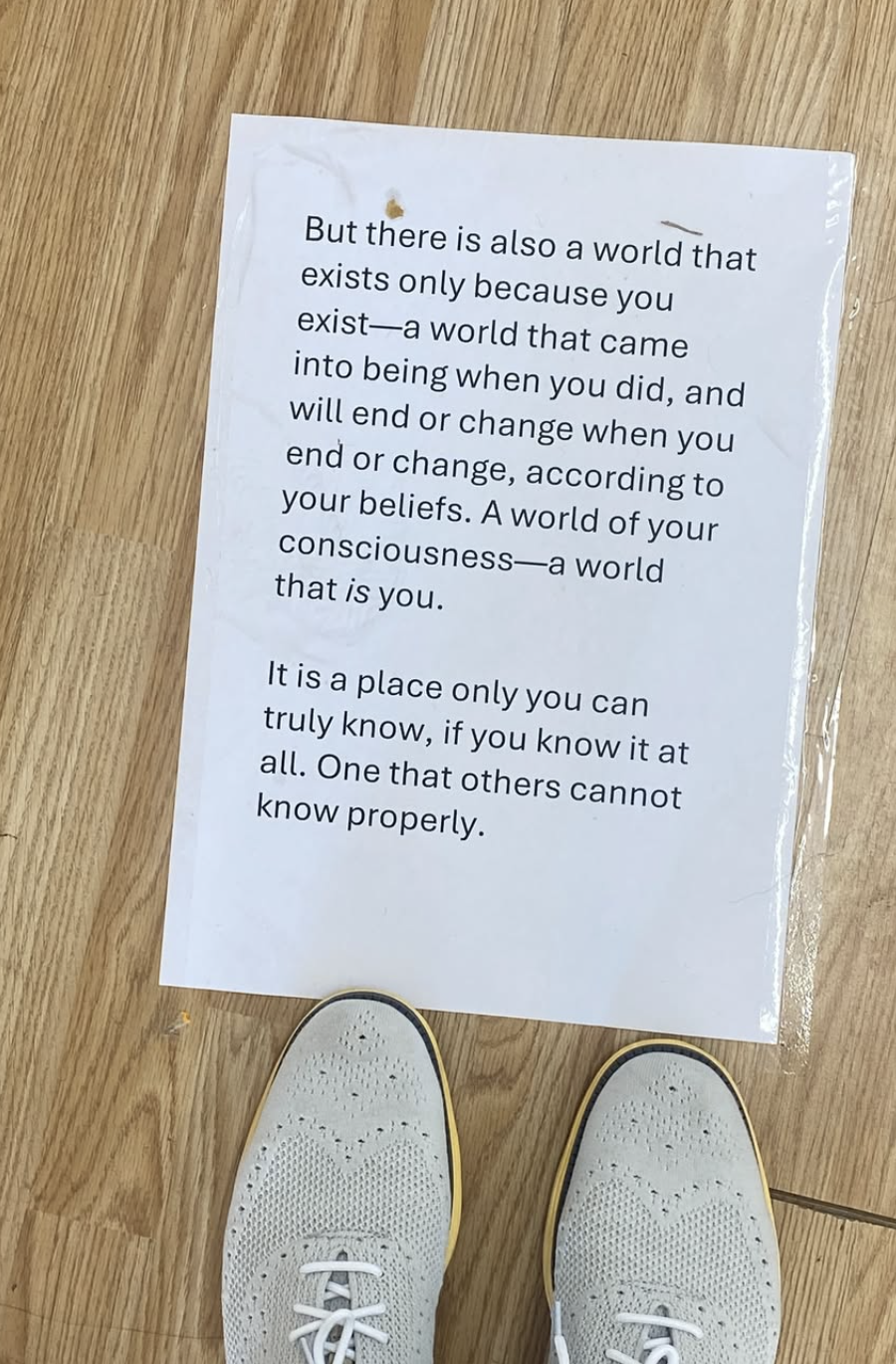
The World That Is You, Consciousness, Belief and Private Being
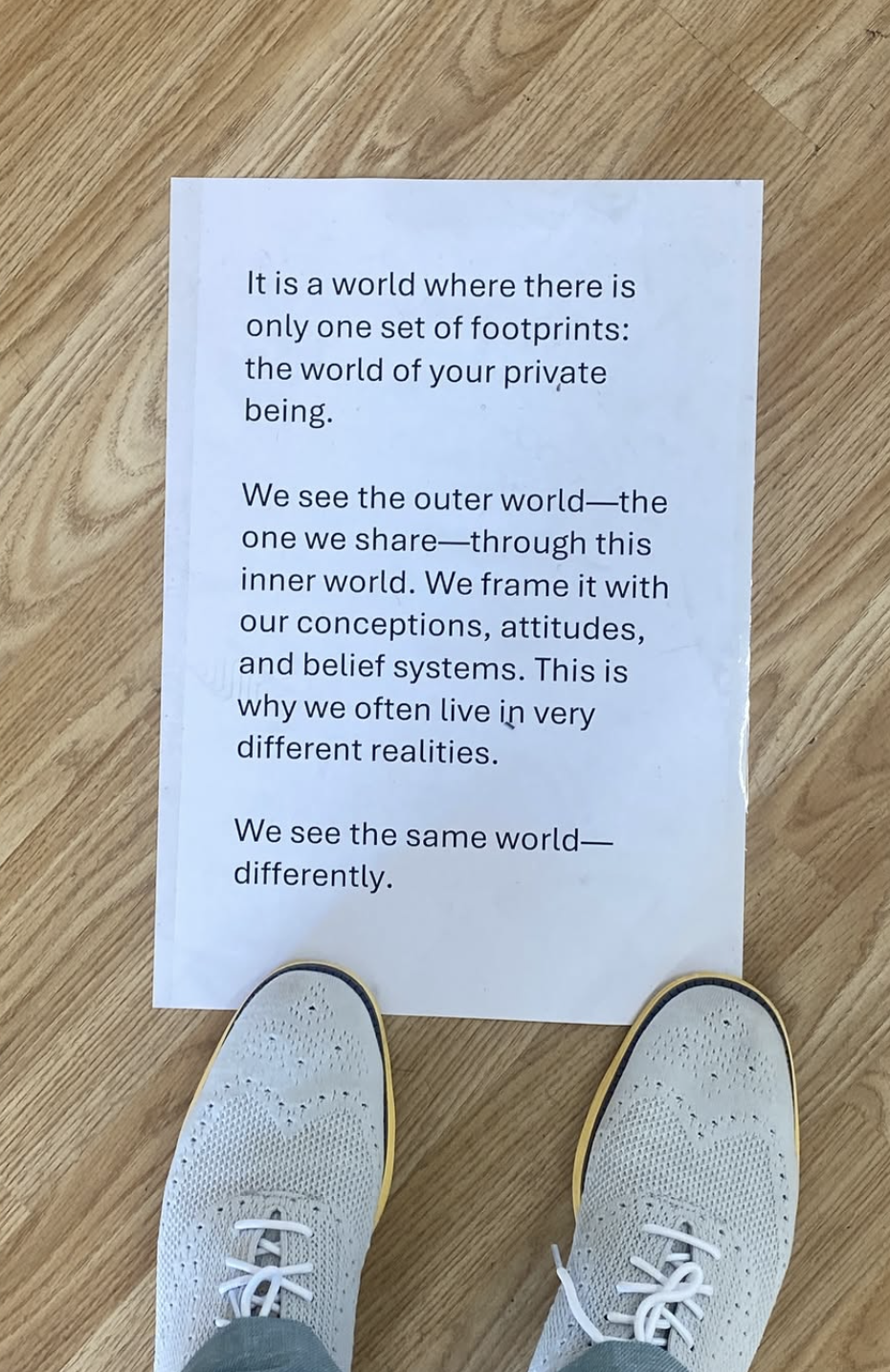
We See the Same World, Differently
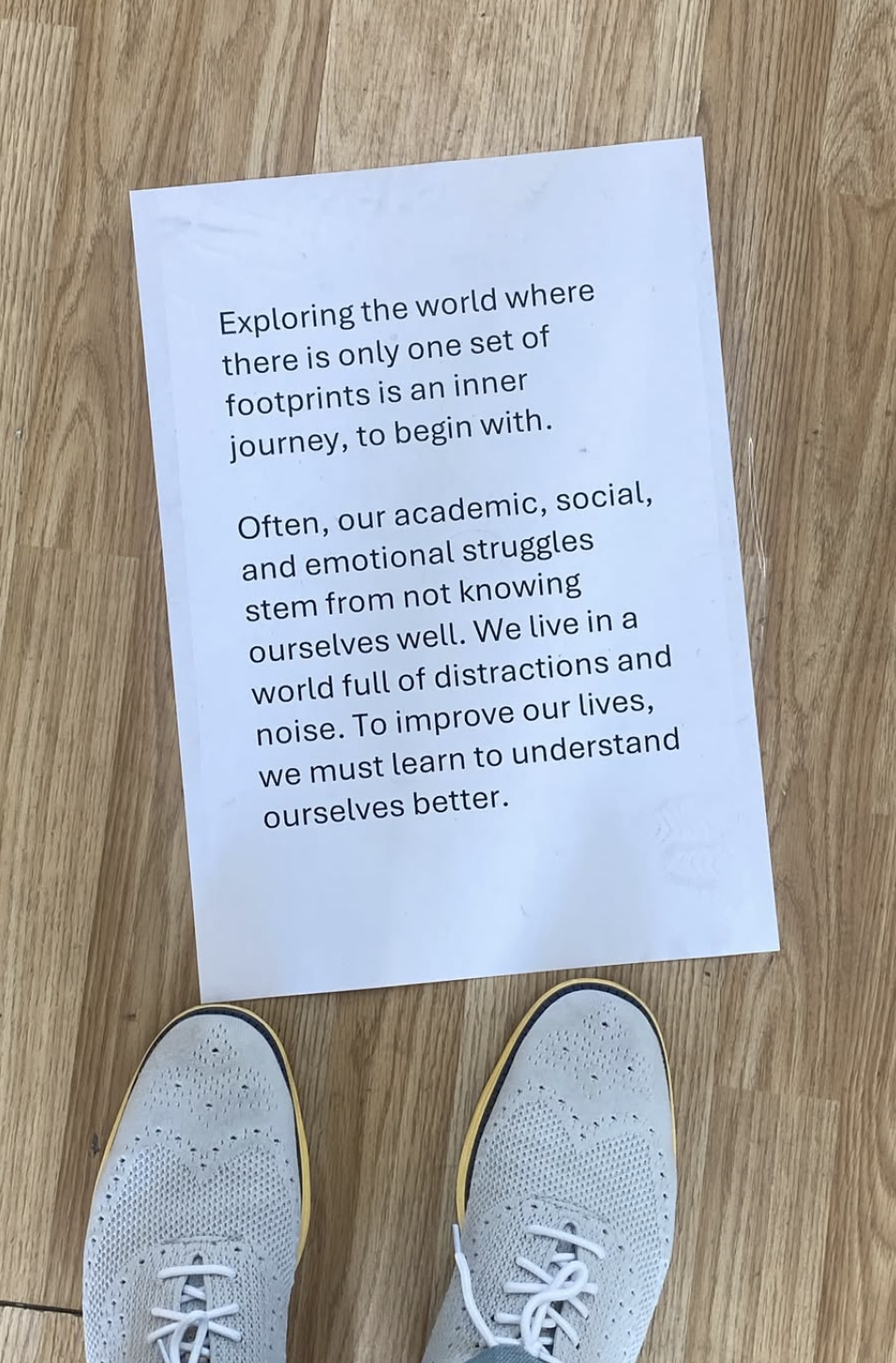
The Inner Journey, Self-Knowledge as the Root of Wellbeing
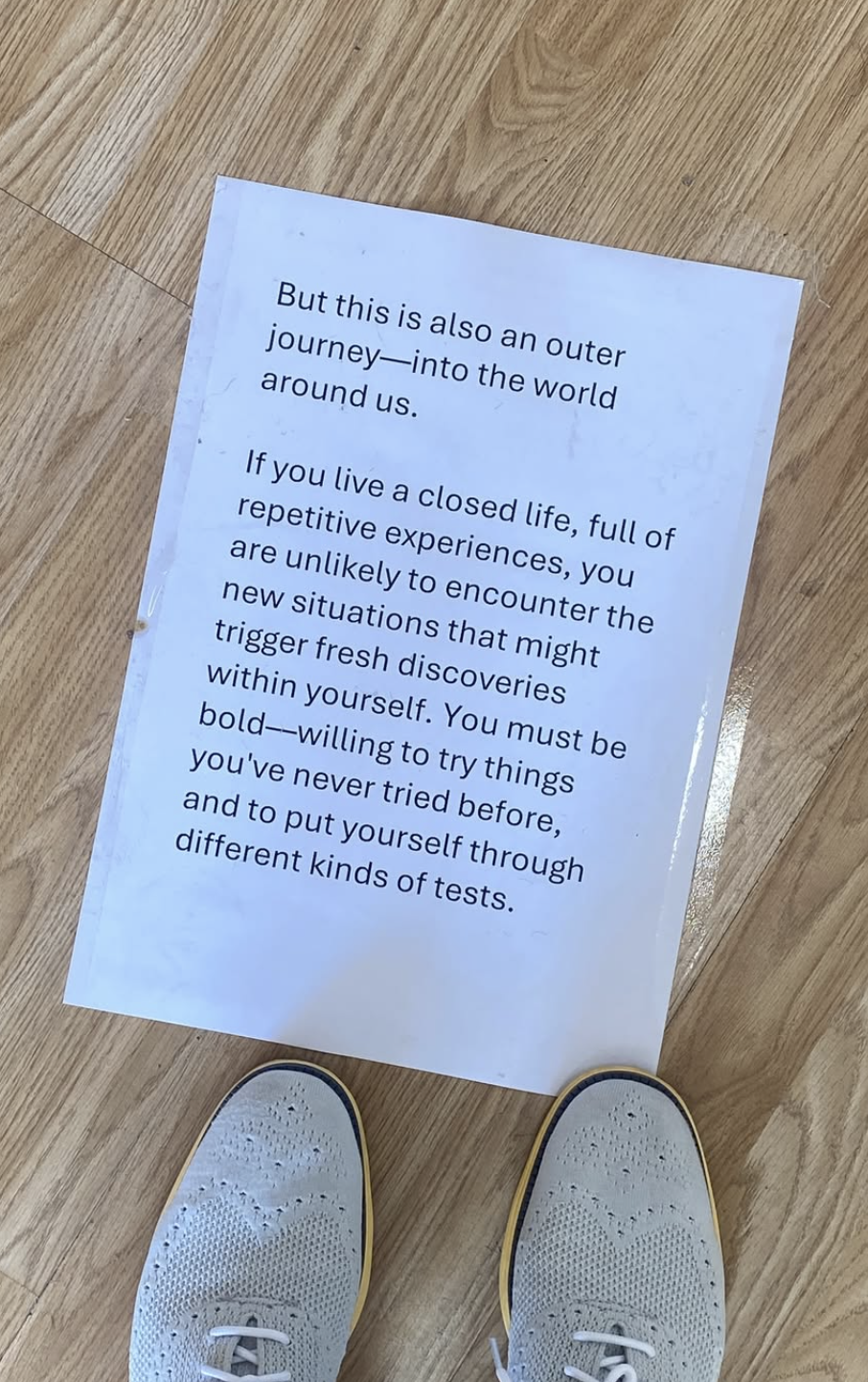
The Outer Journey, Boldness, Discovery and New Experience
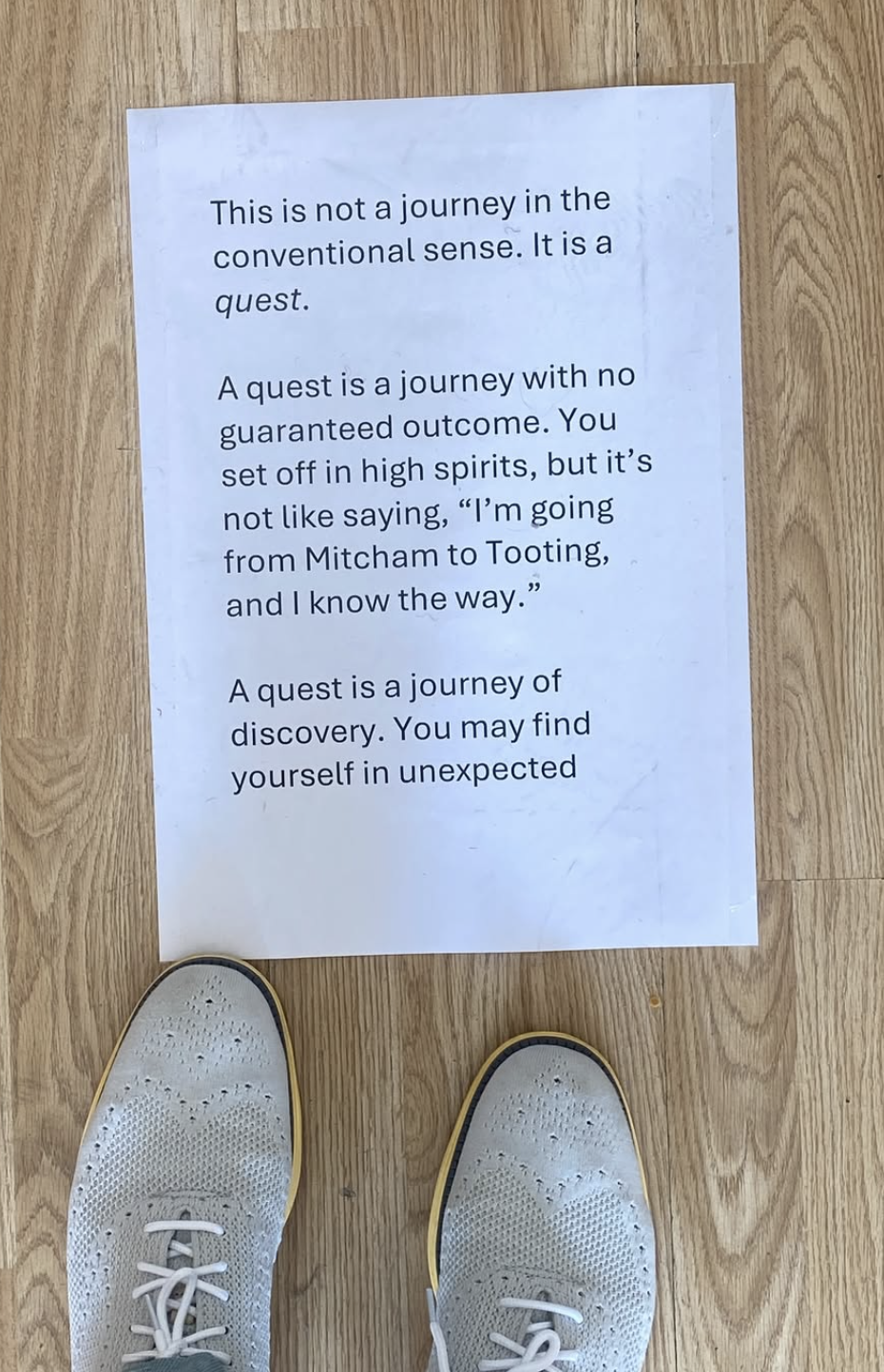
Not a Journey, A Quest. From Mitcham to Tooting and Beyond
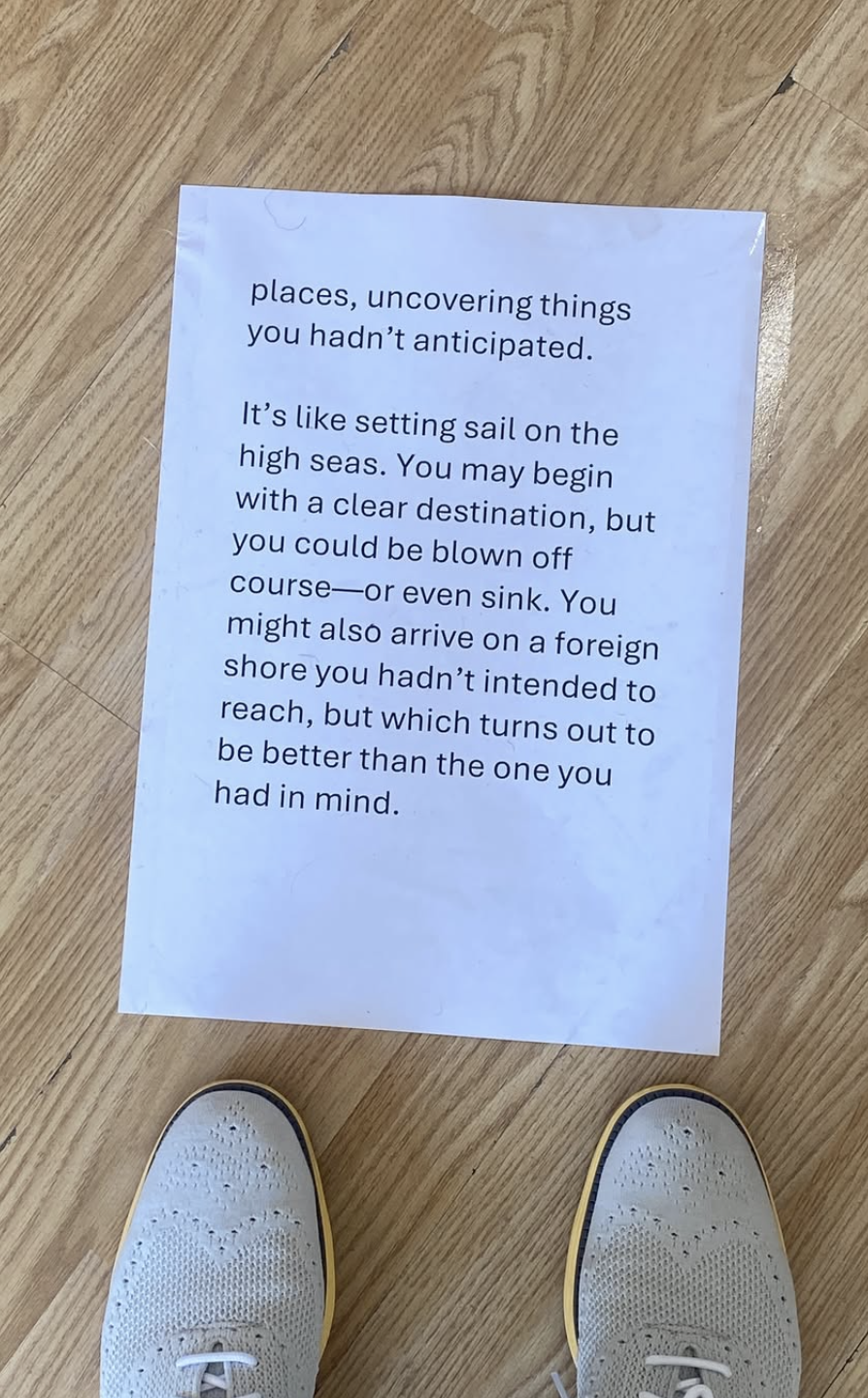
Setting Sail: Unexpected Places and the Shore You Hadn't Planned For
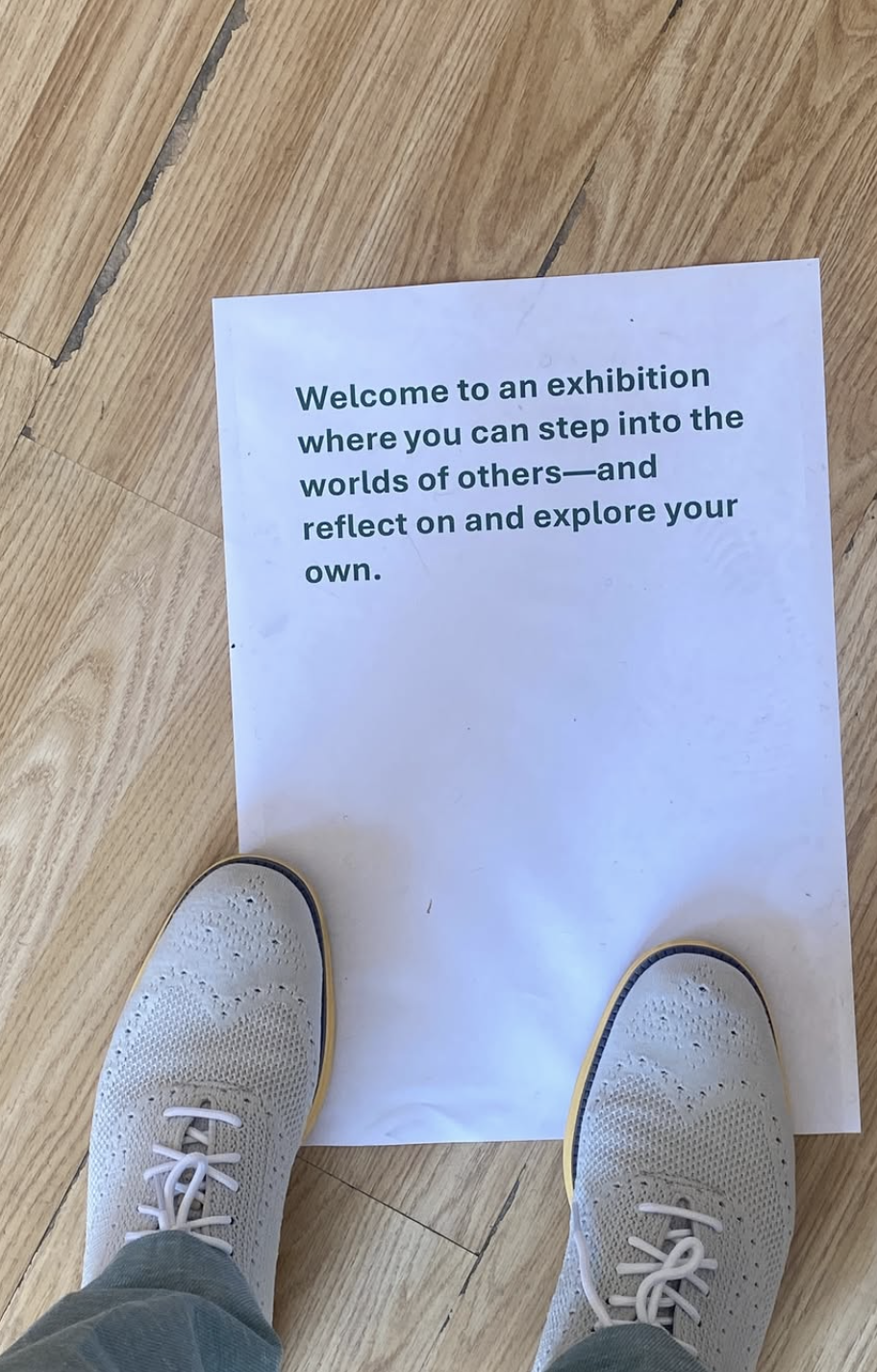
Welcome: Step Into the Worlds of Others, and Your Own
The invitation
"Welcome to an exhibition where you can step into the worlds of others, and reflect on and explore your own."
This is where it begins. Feet planted directly on the words. An invitation to every young person, teacher, family member and social care professional who walked through: this space is yours to inhabit.
two worlds
"We all live in two worlds. There is a world that exists whether or not you exist, a world that pre-existed you and will persist beyond you. A world of other people, objects, and events."
Where all honest self-inquiry begins. The world was here before you and will persist after. This is the shared world, the one we are all required to negotiate, together.
the world that is you
"A world of your consciousness, a world that is you. It is a place only you can truly know, if you know it at all. One that others cannot know properly."
The most private place any person will ever inhabit. And yet many young people with learning differences are not encouraged to explore it, let alone given the conditions to begin.
one set of footprints
"It is a world where there is only one set of footprints: the world of your private being. We see the same world, differently."
The line that names the whole exhibition. The inner world is not a problem to solve. It is the lens through which every outer experience is filtered. That is why real empathy must begin here.
the inner journey
"Often, our academic, social, and emotional struggles stem from not knowing ourselves well. We live in a world full of distractions and noise. To improve our lives, we must learn to understand ourselves better."
Not a soft observation, a clinical one. Young people are often told their struggles are behavioural, cognitive, or social. Rarely are they told: it begins with knowing yourself.
the outer journey
"You must be bold, willing to try things you've never tried before, and to put yourself through different kinds of tests."
The inner world and the outer world are not separate. Growth requires both. For young people with SEND vulnerabilities, creating the conditions for safe boldness is one of the most challenging, yet meaningful things we can offer.
a quest
"It's not like saying, 'I'm going from Mitcham to Tooting, and I know the way.' A quest is a journey of discovery. You may find yourself in unexpected…"
Mitcham. Tooting. Two south London areas carrying the weight of something universal. The self-knowledge journey doesn't begin in a lecture hall. It begins on roads these young people already know.
the unexpected shore
"You might also arrive on a foreign shore you hadn't intended to reach, but which turns out to be better than the one you had in mind."
For so many families connected to this work, this is the whole story. The destination they planned for wasn't the one they arrived at. But the shore they're standing on, if supported well, can be extraordinary.
Brief summary
Kevin George, BACP-registered clinical therapist, senior family therapist, and author of Soccology, reflects on The World of Self: an art exhibition laid as eight sequential text panels on a south London school floor, shaped by phenomenological ideas about inner and outer experience. Designed for young people with SEND vulnerabilities, their teachers, their families and social care workers, using art to go where words alone so often fail to reach.
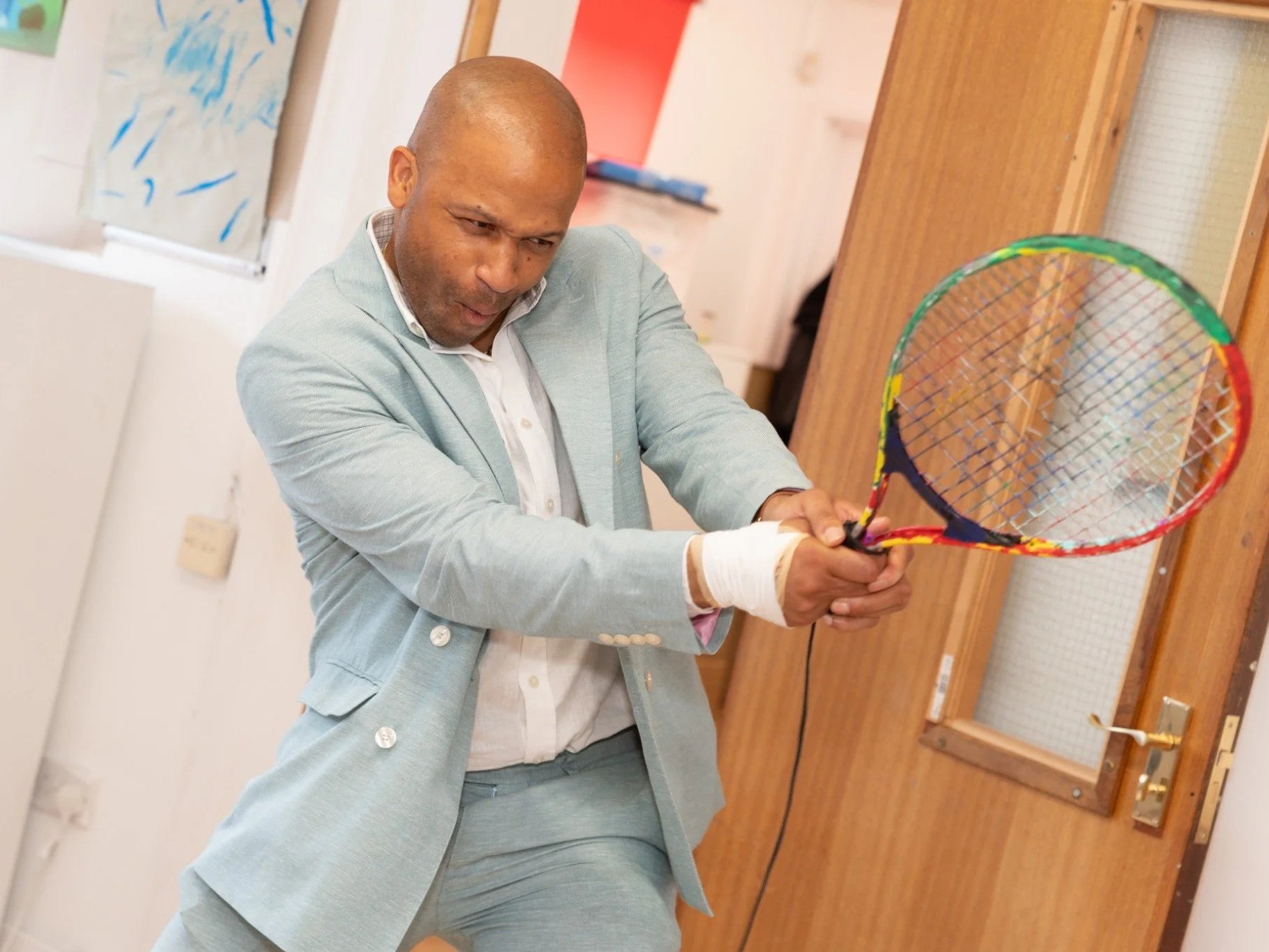
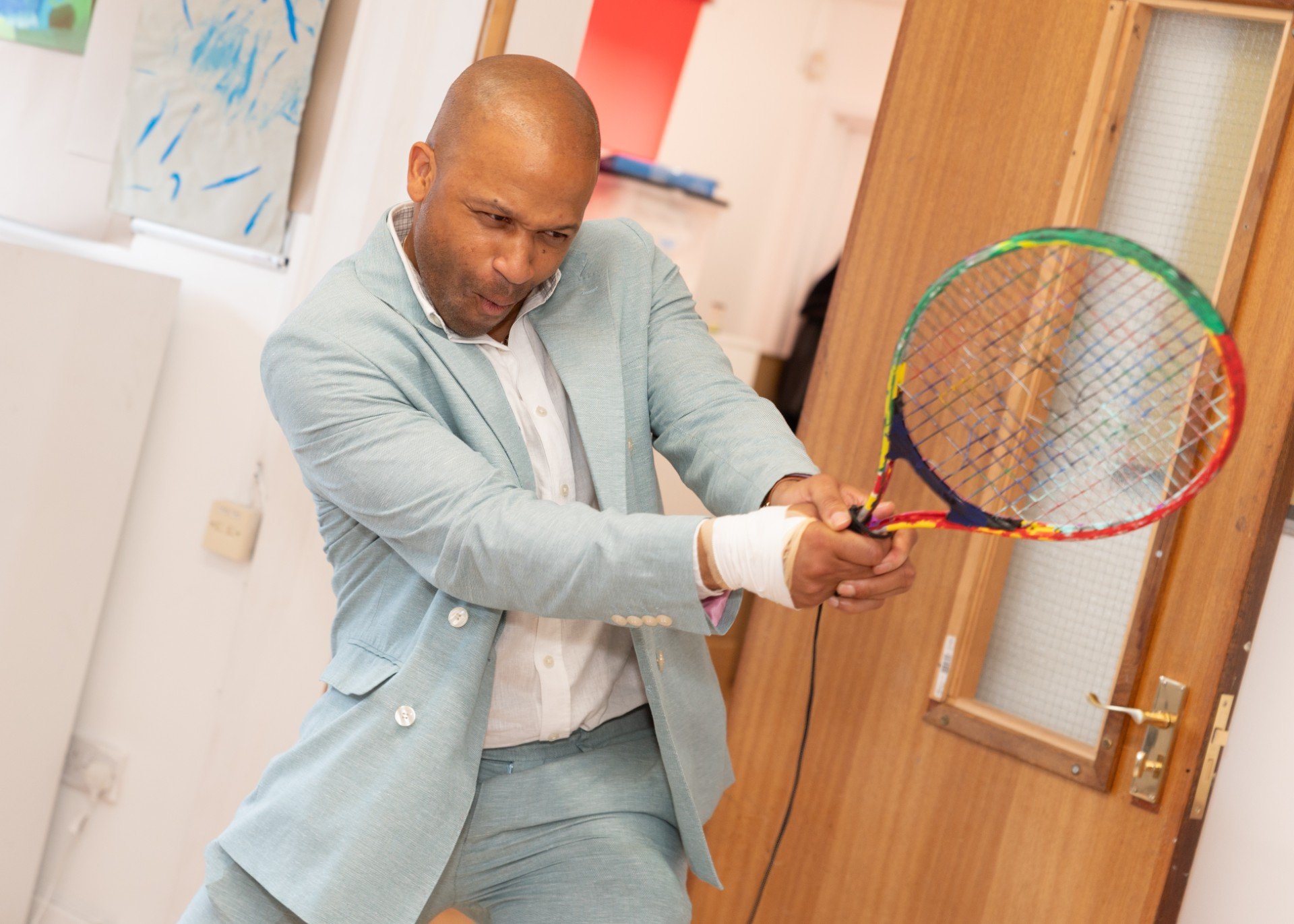
Kevin George at ‘A World Where There's Only One Set of Footprints’ Art Exhibition for SEND Students
We all live in two worlds
Not with a theory. Not with a clinical framework. Just a plain statement of human fact. And for the young people who walked through this exhibition, some of whom have never had the language to describe the gap between who they are inside and how they appear to the world, those six words did something. They made the invisible visible. They said: your inner world is real. It counts. It has a name.
I didn't plan to write about this. The work itself was personal, close to specific young people, specific rooms, specific moments I'm not in a position to share publicly. But the references that formed the backbone of the exhibition are public. The thinking behind it belongs to all of us. And now that it has lived in a space, been walked through, been read from the floor upward, it deserves to breathe in the open.
A note on the poem itself: the eight panels are original text, written for this exhibition. They are not verbatim quotations from any published author, and I want to be precise about that rather than lend them a borrowed authority they haven't earned. What I can say honestly is where the thinking underneath them came from.
The thinking behind the exhibition: Laing and Witkin
The idea that we inhabit two worlds at once, a shared world that pre-existed us and will persist after us, and a private world that only we can ever fully know, sits at the centre of twentieth century phenomenological psychiatry and, from a different angle, in the reflections of at least one photographer who spent his career working at the edge of what can and cannot be shown.
Ronald David Laing (1927–1989), the Scottish psychiatrist and radical phenomenologist, spent his career asking a question mainstream psychiatry largely avoided: what does it actually feel like to be you? Not what your symptoms suggest. Not what your diagnosis implies. Laing's landmark work The Divided Self gave language to the experience of ontological insecurity, the sense of being fundamentally disconnected from a world that seems designed for other people. For young people with SEND vulnerabilities, that phrase lands differently than Laing may have intended. The school system, however well-meaning, is in many ways a world built for a particular kind of mind. Young people who don't fit that template are not broken. They are navigating an additional layer to the two worlds simultaneously, every single day, with often very little support for the one that is entirely and irreducibly their own.
Robert W. Witkin (b. 1934), the British sociologist whose academic home was the Department of Sociology and Philosophy at the University of Exeter, spent his career asking a related but different question: how does raw, unformed feeling become something a person, or a child, can actually think with? Not simply express it. Not simply release it. Witkin's landmark 1974 work The Intelligence of Feeling argued that the arts are not a soft add-on to education but a discipline in their own right, the means by which felt, sensate experience is given form and becomes intelligible, first to the person having it, then to everyone else. For young people with SEND vulnerabilities, that argument carries particular weight. So much of what they feel internally has no accepted shape, no sanctioned outlet, no format the curriculum is built to receive. Witkin's insight was that this is not a failure of intelligence. It is a failure of form. Give feeling a shape it can move through, and it becomes something that can be known, shared, and understood, not just endured.
Neither Laing nor Witkin is being quoted directly in the exhibition panels. What they offer instead is a frame, phenomenology on one side, the discipline of turning raw, unshaped experience into something perceivable on the other, that the exhibition's own words were written inside of.
The exhibition also leans on the spirit of Footprints in the Sand by Mary Stevenson, a poem widely known for the image of a single set of footprints belonging to a person walking through their own difficulty, largely alone.
Eight pages on a floor
The visual form of the exhibition was deliberately simple. Eight A4 text panels, printed and placed in footpath sequence on a warm oak school floor. Where people moved their feet through the panels one by one, whilst reading.
The feet are not incidental. The feet are the one set of footprints. Every time a person stood over one of these pages and read it, they stepped out of the shared world and into their own world. Running simulations of the past, explorations of the present and tweaking the landscape.
When you look at something on a wall, you observe it. When you stand over it on the floor, you inhabit it. Looking downward usually refers to eye-accessing cues for accessing feelings or internal self-talk. For people whose inner lives are so rarely given physical form, that difference is not aesthetic. It is psychological.
Once people completed their journey on the path, they progressed onto the artwork. Where they were not looking at someone else's inner world from a distance. They were now sensorially primed to experience the world of others.
From Mitcham to Tooting, and why that matters
Buried in panel six of the poem is a reference that might look like a throwaway line.
"It's not like saying, 'I'm going from Mitcham to Tooting, and I know the way.'"
It isn't throwaway at all. Mitcham. Tooting. Two places in south London that anyone from this part of the world knows on their skin, the roads, the bus routes, the particular texture of those streets. For a young person from Lewisham, from Mitcham, from Tooting itself, those names do something that abstract philosophical language cannot: they say this is about you. This world is your world. This quest begins on streets you already know.
That grounding is something I am committed to across all of my work, clinical, creative, and community. Growing up in south London, working in south London, building projects in and for south London communities. I've seen what happens when young people encounter ideas or frameworks that seem designed for someone else's geography, someone else's culture, someone else's experience of the world. They disengage. Not because they're not intelligent, often extraordinarily so. But because nothing in what they're being shown is showing them back to themselves.
Mitcham to Tooting says: I see where you're from. And this quest, this inner journey with no guaranteed outcome, starts on your roads, not someone else's.
"It is a world where there is only one set of footprints: the world of your private being. We see the outer world, the one we share, through this inner world. We see the same world, differently." - From references used for exhibition.
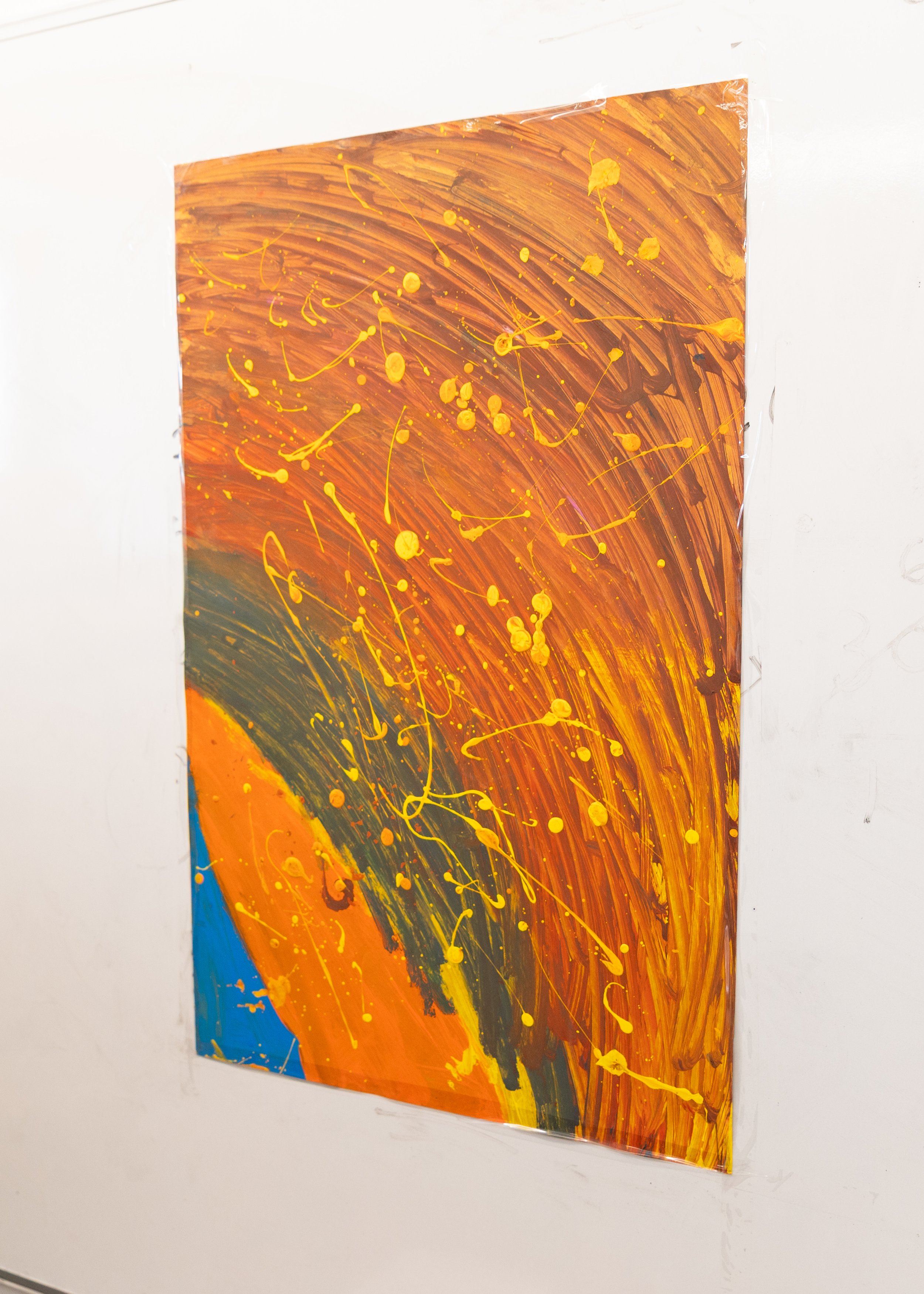
An Art Piece from Kevin George’s ‘A World Where There's Only One Set of Footprints’ Art Exhibition for SEND Students
A quest, not a journey
The exhibition refuses the comfort of a map. It names what self-discovery actually is: not a journey, a quest. A journey implies a known route and a predictable arrival. A quest is something else entirely, you set off in good faith, you encounter what you encounter, and you may arrive somewhere you never intended, which turns out to be better than the place you had in mind.
For teachers, that framing has real weight. So much of what happens in educational settings is implicitly map-based: here is the curriculum, here is the target, here is the expected trajectory. For many young people with SEND vulnerabilities, that map doesn't match the territory of their actual experience. They are not failing to follow the route. They are on a different kind of journey altogether, one that requires a different kind of support.
For families, it may feel closer to the bone. The parent who received their child's EHCP for the first time. The one who sat in the assessment waiting room. The one who has moved through exclusion meetings, referral pathways, and tribunal processes, trying to translate the full complexity of who their child is into formats that institutions can process. They know what it is to set off with a clear destination and find themselves somewhere unexpected. The exhibition says: that unexpected shore might be better than the one you had in mind. Hold onto that.
Where words fall short, art steps in
This exhibition was not designed to be aesthetically ambitious. It was designed to be useful. To fill the space that clinical language, parental language, the language of annual reviews and school reports, so often cannot reach.
Many of the young people I work with, and many of the parents I sit with in family therapy, arrive at moments where the words simply run out. Not because they have nothing to say. Because the gap between what they feel and what language can hold is so wide that they fall silent.
The conventional response is to try harder with words: to reframe, to clarify, to offer a different vocabulary. What this exhibition tried instead was to offer a form that doesn't require words at all. A floor. A pathway. A pair of feet walking through it and walls.
A teacher who had previously struggled to understand why a particular student seemed so disconnected from classroom life stood over one of these panels for a long time. She also stared at the student’s art piece. She didn't say anything afterwards. She didn't need to. Something had moved. To which she voluntarily verified in a debrief.
That is what art can do that a meeting cannot.
FAQ
Was the exhibition poem a direct quotation from R.D. Laing or Robert Witkin? No. The eight panels are original text, written for this exhibition. They were shaped by Laing's phenomenological work on inner and outer experience and by Witkin's reflections on the intelligence of feeling. Neither thinker is quoted verbatim in the exhibition itself.
Who was the exhibition designed for? Young people with SEND vulnerabilities, particularly those with significant challenges around reading social cues, self-expression, and abstract thinking, patterns often associated with ADHD and autism, along with their teachers, families, and social care workers.
What is interoception, and why does it matter here? Interoception is the sense of what is happening inside your own body and internal state. Many young people with SEND vulnerabilities have differences in how they process interoceptive signals, which can make it harder to identify, name, and communicate their own emotional and physical experience. The exhibition was built to promote interoceptive awareness in the students who created it, and to help others feel, rather than simply observe, that inner experience.
Why was the exhibition laid on the floor instead of hung on a wall? Standing over a panel and reading it downward creates a different psychological relationship to the text than viewing it on a wall. It asks the visitor to inhabit the words rather than simply observe them, echoing the exhibition's central idea of one set of footprints belonging to the person walking their own inner path.
What does "Mitcham to Tooting" refer to in the poem? It's a deliberate south London reference. Using local, recognisable places rather than abstract philosophical language grounds the idea of a self-knowledge "quest" in streets the young people already know, rather than in someone else's geography or frame of reference.
Is this exhibition part of a wider programme? It sits within Kevin George's broader work in SEND education and clinical practice, alongside programmes such as KTDA! (Keep The Dream Alive) and Hip Hop Health, which use psychoeducation, sport, and culture to reach communities that traditional clinical language often fails to reach.