Hip Hop and Men's Mental Health: Not Allowed to Be Traumatised
This men's mental health month I am promoting two tools that have held boys and men when little else did: football and hip hop. In my last article I explored football as the accidental therapist. This one is about hip hop, and about a culture that says one thing about men's mental health and does another.
There’s an international push for men to open up and that men’s mental health problems will be met with the support they need. However, in practice this has been conditional. Low mood and sobbing is greated with empathy while self preservative behaviours and panic are met with relational aggression. We’ve seen this in responses to Kanye West’s public episodes, and after I gave a talk in HMP Pentoville, most of the members of the prison population that were present rushed towards me to share their of how their fear, panic and neurodivergence and neurodivergence presented in loud and aggressive tones (not harming anyone), with those met to serve and support misjudging them and treating them like perpetrators.
Misunderstood boys become misunderstood men. I can share many stories and provide a lot of data to support this take however, it will be far removed, instead I want to introduce you to some boys.
The Boys
Read each of these slowly. They are all real.
A boy whose mother was pregnant with him while she was in jail, and who later watched her become addicted to drugs.
A boy whose parents separated when he was eleven, and who by his own account had picked up charges for selling crack by the age of twelve.
A boy who sold drugs as a teenager, watched friends use and die, became emotionally numb and contemplated ending his life.
A boy who grew up with economic scarcity, community violence and street violence.
A boy who was sexually abused at fourteen by a thirty year old woman, grew up around gang violence and kept the abuse inside for years.
A boy who was the youngest of eight children in a home with little money and a father who drank.
A boy whose mother struggled with alcohol, whose father was absent, and who was raised by his grandmother, through eviction and food stamps.
A boy who, at four years old, watched his father shoot his mother and his grandfather in their home.
A boy whose father was sentenced to 120 years in prison when he was two months old.
A boy whose father was murdered when he was one, and whose mother, who struggled with addiction, was murdered when he was in high school.
A boy who, at three years old, witnessed his parents being killed in their home.
A boy who grew up with one brother who would die young and another who would spend his life in prison.
A boy who walked into his house smiling at ten years old and was asked by his father what he had to be happy about. He says he didn't smile again until he was twenty one.
A boy in foster care from third grade to tenth, who saw his first murder at six years old.
A boy who lost his mother, was moved across the country, and was kicked out of nearly every school in his city.
A boy whose mother knocked two of his teeth out with a broom when he was six, and who at fourteen was handed a blunt laced with crack by an older man he looked up to.
(update the above with the information added in the section ‘Who They Became’)
Now the question.
Should we empathise with these boys? Should we try to understand how what happened to them could shape their behaviour as adults? Not to excuse it. Not to remove accountability. But to be mindful that a child can be traumatised by what happened to him, regardless of the job he goes on to do as a man.
Most people answer yes. Not a free pass without consequences but Most people would want these boys to be supported, empathised with and understood. As young boys and men, serving them and us as a global community as we raise our emotional literacy. Hold on to that answer.
Who They Became
Every one of these boys grew up to be a man in hip hop, across four decades of the culture.
1. Busta Rhymes (Gen X)
By the age of 12, he had been arrested twice for selling crack cocaine.
His mother intervened and moved him from Brooklyn to Long Island to remove him from the environment.
He has spoken about his difficult relationship with his father and the pressure he experienced growing up.
Music and hip-hop became an alternative to street life.
2. Jeezy(Gen X)
Grew up experiencing family instability, moving around because his father was in the military.
He has discussed losing friends, exposure to violence and having to take responsibility for providing for his family at just 14.
Sexual abuse by his baby sitter and ***He also described another traumatic experience involving an older woman who lived near his family.
Has spoken about depression and emotional struggles.
Experienced family instability and significant adversity growing up.
His music frequently explores poverty, violence, grief and survival.
Experienced sexual abuse as a child by an older female babysitter.
3. YG (Millennial)
His family attempted to move him away from the neighbourhood and its gang culture. Despite this, he returned to Compton because it was the environment he knew.
Became involved in gang activity, robbery and residential burglaries. As a member of the Tree Top Piru Bloods.
Was incarcerated during his youth.
Experienced sexual abuse at the age of 14. Disclosed that an approximately 30-year-old woman sexually abused him. Explored the experience in his 2025 song ‘2004’.
Spoke publicly about the importance of sharing his experience, particularly as a male survivor of sexual abuse.
4. Irv Gotti (Gen X)
Grew up in Queens, New York, in a family of eight children.
Described coming from a financially struggling background.
5. Ab-Soul (Millennial)
Diagnosed with Stevens-Johnson syndrome as a child, a rare condition that affected his skin and eyesight.
Experienced the death of his long-term girlfriend, by suicide.
Ab-Soul's childhood best friend and close associate was murdered during a home invasion in 2021. His death had a profound impact on Ab-Soul.
Has discussed the psychological impact of these experiences. Has used music to explore his pain and personal struggles.
Has depression and attempted suicide
6. Mad Skillz (Gen X)
His biological mother died from a heroin overdose.
His biological father also died from a drug overdose.
He discovered more about his parents' substance misuse and deaths as he got older.
Learning about their history through conversations with his grandmother became a therapeutic experience.
Explored their lives and deaths through his music.
7. LL Cool J (Gen X)
At four years old, witnessed his father shoot his mother and grandfather in their Queens home.
Both his mother and grandfather survived the shooting.
Experienced physical abuse from his mother's subsequent partner.
Has spoken about the impact of his childhood experiences.
Music became an important outlet and pathway towards success.
8. Bobby Shmurda (Millennial)
His father was sentenced to 120 years in prison for robbery and assault convictions. Bobby was approximately two months old when his father was imprisoned.
Bobby has spoken about having difficulties with school. He has been reported as saying that he had ADD (Attention Deficit Disorder).
Has spoken about becoming independent at an early age and becoming involved in street activity.
Bobby was released from prison in 2021 after serving time for his own conviction.
His father was released in June 2026 after spending more than 30 years in prison.
9. Black Thought (The Roots) (Gen X)
His father was murdered before he turned one.
His mother developed a crack cocaine addiction.
His mother was murdered when he was approximately 16 years old.
Her body was discovered in a morgue after she had been missing.
She had been stabbed to death.
Has spoken about the profound impact of losing both parents.
Explored his childhood experiences in his memoir, The Upcycled Self.
10. Napoleon (Outlawz) (Gen X)
Born Mutah Beale
Napoleon said that his father was a diamond dealer, successful and had multiple homes, which led to him being murdered for his money.
Both parents were murdered in front of him when he was approximately three years old. The murderers were his father’s friends, their grew up with his father and one of them was his Napoleon’s godfather, who referred to Napoleon’s grandmother as his mother.
His father was shot in the chest and died instantly. His mother ran around the house to collect him and his brothers, they shot her thirteen times before she passed away. Before being murdered Napoleon’s mother hid his six month old brother in a chester drawer. Napoleon was shot in the foot.
Napoleon and his two brothers were with his parents dead bodies of their parents for a day to a day and half.
His grandmother subsequently raised him.
Earned the name Napoleon due to his “fiery temper” and his “anger issues”, with Tupac saying he had a “Napoleonic complex”.
Became involved in street life and drug dealing during his childhood and adolescence.
Later joined Tupac's rap group, the Outlawz, and developed a close relationship with Tupac Shakur who cried when Napoleon shared the story of his parent’s murder when they first met.
Also experienced the murders of close associates Tupac Shakur and Yaki Kadafi.
11. Master P (Gen X)
Grew up in the Calliope housing projects in New Orleans, an environment affected by poverty and violence.
His grandparents had 12 children. At one point, 16 people were living in a three-bedroom housing-project apartment. He and his brother slept on the floor because there weren't enough beds.
His family relied on government food assistance (WIC).
He has described seeing the difference between his circumstances and those of wealthier children.
He was also injured playing basketball, ending his hopes of a professional basketball career.
His brother Kevin Miller was killed through gun violence at approximately 18–19 years old. He described watching his mother grieve the death of his brother and deciding to change his own life.
His brother Corey Miller, known as C-Murder, is serving a life sentence.
His daughter, Tytyana Miller, died in 2022 aged 29. Master P publicly discussed her struggles with mental illness and substance abuse. Her death was attributed to accidental fentanyl intoxication.
12. David Banner (Gen X)
Grew up in Jackson, Mississippi, amid significant community violence.
Has described a childhood environment in which happiness and emotional expression were discouraged.
Recalled being 10 years old and coming home smiling and playing. His father challenged him, saying that if he was unhappy despite paying all the bills, why should his son be happy? David recalls that he didn't smile again until he was 21. Has spoken about how this experience affected his emotional expression and outlook on life.
13. 2Pac (Tupac Shakur) (Gen X)
His mother, Afeni Shakur, was a member of the Black Panther Party. She was arrested in 1969 as part of the Panther 21 case, accused of conspiracy to bomb buildings in New York.
She became pregnant with Tupac while out on bail. Her bail was subsequently revoked and she spent part of her pregnancy in prison. She successfully defended herself in court and was acquitted in May 1971. Tupac was born on 16 June 1971, approximately one month after her release.
Following his birth, Afeni struggled with poverty and later developed a crack cocaine addiction during the early 1980s.
Tupac experienced considerable instability, including frequent house moves, financial hardship and periods without a stable home.
His relationship with his mother became strained because of her addiction.
He eventually reconciled with her and dedicated Dear Mama to her, acknowledging her struggles as a single mother.
The list goes on beyond childhood. Kid Cudi, who lost his father as a boy, checked himself into rehab in 2016 for depression and suicidal urges, writing: "I am not at peace." Ab-Soul spoke in 2022 about surviving a suicide attempt. Lil Baby (reference his depression and childhood adversity) has said he "wasn't in the right headspace" when he released a number one album.
Now ask yourself again. Do they deserve the same empathy you gave the boys?
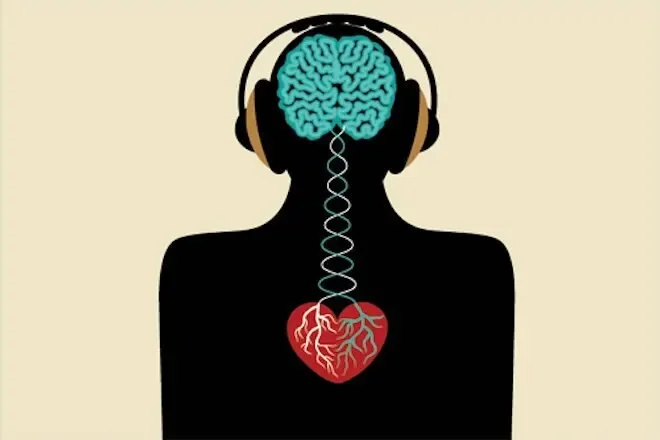
Not Allowed To Be Traumatised
For many people, the answer changes the moment the names appear. The boy tearful boy crying into his hands deserved our empathy. The rapper with the platinum plaques does not. He has money. He has fame. He chose this life. He should be grateful.
We have decided that success cancels out childhood. That a record deal reaches back in time and undoes a father's gunshot, a mother's addiction or an abuser's hands. It does not. Adverse childhood experiences shape the developing brain, the nervous system and the beliefs a child forms about himself and the world. The research on adverse childhood experiences has shown for decades that the more of them a child endures, the greater the risk to his mental and physical health as an adult. Fame does not appear anywhere in that research as a cure.
Money can buy distance from the environment. It cannot buy distance from the nervous system the environment built. In many cases, fame makes it harder: more pressure, more scrutiny, more people who need you to keep performing, and fewer people who will tell you the truth.
Ye as a case study
No one in the culture shows this more publicly than Ye, formerly Kanye West.
He disclosed a bipolar diagnosis, writing "I hate being Bi-Polar it's awesome" on the cover of his 2018 album. In 2025 he said he had been misdiagnosed and has autism instead, and that he had stopped taking medication.
Around that, we watched what looked like a man dismantling his own life in public. He spoke about his first child and abortion at a 2020 political rally, exposing his then wife. He turned on the people closest to him, including his "big brother" Jay-Z and Jay-Z's children, and friends such as Kid Cudi, Pusha T and John Legend. He said slavery "sounds like a choice". He made antisemitic statements that cost him major business partnerships, released a song glorifying Hitler and wore a Ku Klux Klan style hood.
Let me be clear. None of this is excused. Antisemitism and racism cause real harm to real people, and accountability matters.
But look at how we responded. The same culture that posts "check on your strong friend", “Be Kind” and "it's OK not to be OK" turned a man's apparent unravelling into memes, reaction videos, podcast segments and engagement. We did not ask what was happening to him. We asked what he would say next.
What this communicates
We say we want a culture that is open, that encourages men to speak, that understands how experiences shape them and that wants to support them. What our behaviour communicates is that we are all of those things when mental health presents itself in a form we find palatable: a tearful interview, a heartfelt caption, a hashtag.
When it presents as anger, paranoia, offensive outbursts, self sabotage or a man burning down every relationship he has, the empathy disappears. Yet those presentations are often exactly what unprocessed trauma looks like in men.
Gimmicks And The Behaviours We Accept As Normal
In the attention economy, the gimmick wins. The outburst gets more views than the explanation. The breakdown gets more clips than the recovery. The man who says something outrageous trends; the man who quietly checks himself into rehab gets a day of supportive comments and is forgotten.
This rewards the very behaviours that signal a man is struggling. It also teaches the audience, especially boys, what gets noticed.
Alongside the gimmick sit the behaviours we have accepted as normal for so long that we no longer see them:
Calling a man "crazy" or "done" rather than asking whether he is unwell.
Laughing at a public breakdown and sharing it before we have understood it.
Celebrating lean, pills and heavy drinking in lyrics and on social media while ignoring what they are often medicating.
Treating absent fathers, violence and grief as the standard backdrop of a rapper's story rather than as trauma.
Telling boys to "man up", then asking men why they don't speak.
Think of it like a smoke alarm. Each of these behaviours is the alarm going off. A culture that laughs at the noise, or turns the alarm into a ringtone, is not dealing with the fire.
The Culture We Say We Want Versus The One We Create
Our stated culture and our lived culture are pulling in opposite directions.
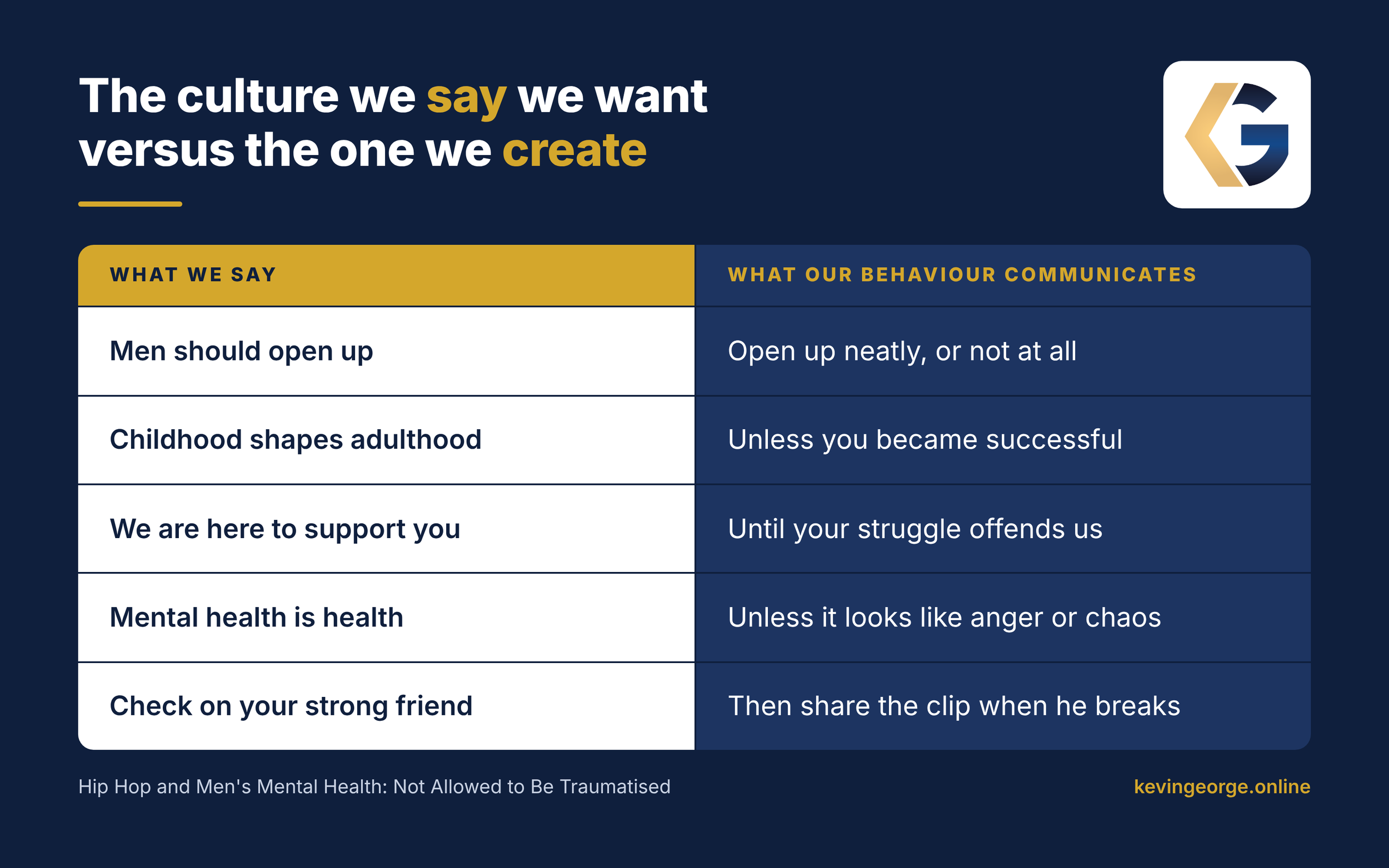
Boys watch this. They see which pain gets support and which pain gets mocked. They learn that the safest option is to hide it, the same safe decision I wrote about in Courage Over Comfort. Silence protects the image and harms the health.
Hip hop has always told the truth about where these men come from. "Dear Mama", "2004" and countless other records are case studies in adverse childhood experiences, written by the people who lived them. The culture around the music has not caught up with the honesty inside it.
What We Can Do
As fans and audiences. Before you share the clip, ask what you might be watching. Hold accountability and empathy at the same time; they are not opposites. Stop rewarding the gimmick with your attention.
As media and platforms. Report the origins, not just the outburst. When a public figure's behaviour changes suddenly, consult clinicians, not just commentators.
As parents, schools and youth workers. Use hip hop as a tool. Lyrics written by men who survived adversity are some of the most powerful psychoeducation available to young people. They let a boy recognise himself in someone he respects, and name what he has never had words for.
As men. Your story did not stop counting because you grew up, got paid or got famous. What happened to you as a boy still matters. So does what you do with it now.
Key takeaways: adverse childhood experiences do not expire with success. Our culture offers empathy for palatable pain and withdraws it when pain looks like anger or chaos. Gimmicks win attention while the behaviours behind them go unexamined. Hip hop already tells the truth; the culture around it needs to listen.
About Kevin George
Kevin George is a BACP registered psychotherapist, Senior Family Therapist and former professional footballer with West Ham United and Charlton Athletic. For over 20 years he has worked within education across state schools, SEND schools and alternative provision, and has delivered projects in adult prisons and young offender institutions. He supports families through private and community mental health programmes and runs Cerebro 1:1, his private practice in Beckenham and London Victoria, with sessions also available online. He is the Amazon No.1 bestselling author of Soccology and founder of Soccology CIC, home of the Hip Hop Health programme.
Work With Kevin
Therapy for individuals, couples and families. Kevin offers therapy face to face in Beckenham and London Victoria, and online across the UK, plus a check in subscription for consistent support between sessions. If you recognised yourself in one of those boys, this is a space where your story counts. Explore therapy services
Support for schools. Kevin helps schools use culture, including hip hop and sport, to engage young people in understanding their mental health, with clinical support for pupils, staff and parents. Explore school services
FAQ - Frequently asked questions
Can childhood trauma affect someone who becomes rich and famous? Yes. Adverse childhood experiences shape the brain, nervous system and beliefs a person carries into adulthood. Money and fame can change a person's environment, but not the impact of what happened to them as a child.
What are adverse childhood experiences (ACEs)? ACEs are potentially traumatic events in childhood, such as abuse, neglect, witnessing violence, parental addiction, imprisonment of a parent or losing a parent. The more ACEs a child experiences, the greater the risk to their mental and physical health as an adult.
Which rappers have spoken about mental health and childhood trauma? Many, including Jeezy, Gucci Mane, YG, Black Thought, Kid Cudi, Ab-Soul, DMX, Master P, David Banner and The Game.
Does understanding trauma mean excusing behaviour? No. Empathy and accountability can exist together. Understanding why someone behaves the way they do helps us respond in ways that reduce harm and support change.
Why don't men talk about their mental health? Boys learn early which kinds of pain are supported and which are mocked. When men's struggles show up as anger or chaos and are met with ridicule, silence becomes the safest choice.
How can hip hop help young people's mental health? Hip hop lyrics often describe adverse experiences in the artist's own words. Used intentionally in schools and youth work, they help young people recognise their own experiences, build emotional vocabulary and see that recovery is possible.