
Football: The Accidental Therapist. How the Game Healed Boys and Men, and Why It Is Losing That Power
This week we enter men's mental health month. This November I am promoting two tools that have held, shaped and healed more boys and men than most formal interventions ever will: football and hip hop. This article is about football.
In my previous articles I explored how overprotection keeps children frozen in time, how courage separates the remarkable from the safe, and why so many boys become men who don't speak. Football sits at the centre of all three. It is where many boys first met controlled stress, first made brave decisions and first found a place where they were understood without having to explain themselves.
Here I want to share four things:
How football has served as an unintentional intervention for boys and men.
How a lack of understanding of how football served us has led to a loss of its therapeutic power through new policies in the game.
How the reporting of mental health in football has miseducated the public and produced ill fitting solutions.
What I call the "feast" in football.
My focus is the professional game, because what happens at the top trickles down. Thousands of children pass through academies, and millions more learn what football means from how the media covers the professional game.

1. Football as an unintentional intervention for boys and men
I am talking about boys excluded from school, kicked out of their homes and shunned by society. Boys labelled antisocial, who have experienced high levels of adversity, and in many cases neurodivergent.
These boys gravitated to football, and the reasons are clinical, even if nobody at the time used clinical language.
Extended boundaries. A football pitch gives a boy far more space, physically and emotionally, than a classroom. He can run, shout, compete and make contact within rules everyone understands.
Escapism. For ninety minutes the chaos at home, on the estate or in his head is replaced by one clear objective.
Community. A team gives a boy a role, a name and people who notice when he is missing.
Self regulation. A boy who would lash out anywhere else learns to hold it in because he does not want to be sent off and let his teammates down. Football teaches regulation by attaching a consequence he actually cares about.
Positive neurochemistry. Movement releases dopamine, serotonin and endorphins. For a boy with ADHD or a nervous system shaped by trauma, that is not a bonus. It is medicine.
Acceptance of the rejected part. This is the one that matters most. The part of him society rejected, his displaced aggression, was welcomed and rewarded in football. On the pitch it was called "having a bit about you", "having some character", "having some fight". The same energy that got him excluded from school got him selected for the team.
Think of football as a riverbed. A river that floods a town is destructive. The same water, given a channel, powers a mill. Football gave these boys a channel.
Some of these boys went on to have professional careers. Many more were held by the game, nurtured by its therapeutic elements, healed, upskilled and socialised to become active citizens. I have seen it as a player, as a director in alternative provision, and in my work in prisons and young offender institutions.

Using the tool intentionally
If football has done this by accident, imagine what it could do on purpose.
Interdisciplinary education. A boy with ADHD who loves football may not sit still in maths. Ask him to jump one metre, take a ten centimetre step back and record the distance travelled, and the lesson changes. Engagement and attainment increase, and self regulation is maintained because his body is part of the learning rather than the obstacle to it.
Movement as strategy, not reward. Too often movement is treated as a break from learning. It should be a strategy for engagement, regulation and dopamine processing, built into the timetable rather than bolted on to the end of it.
Case studies in policy and PSHE. We have enough research and lived examples of sport succeeding where other interventions have fallen short. These stories belong in policy and in PSHE lessons, where young people can study them, understand themselves and learn to self intervene. Teaching a boy why football calms him gives him the agency to use that knowledge when there is no pitch nearby.
2. How we are losing football's therapeutic power
Performance first, person second
The Elite Player Performance Plan (EPPP), introduced in 2012, brought much needed structure to youth development. But in gaining structure, the game lost something it never realised it had. Rather than studying how the old school saved generations of lost boys, we scrutinised its methods and stripped them out.
The EPPP is, by name, a performance plan. It follows that mental health, wellbeing and psychological support within it serve the persona, the player, rather than the person. And when the person is treated as a means to an end, every role built around them will struggle to achieve its goal.
The framework makes this explicit. The psychological corner is framed around performance:
Focus: Mental skills, emotional well-being, and cognitive development.
Key Aspects: Developing confidence, decision-making, performance under pressure, resilience, and managing game-related stress.
Role in EPPP: Academies utilize sport psychologists and mental welfare programs to help young players cope with the rigorous demands of professional sports. [How well are the Elite Players Performance Plan (EPPP) supporting young players with psychological welfare?]
The social corner, by contrast, is framed around the person:
Focus: The human element, relationships, and lifestyle.
Key Aspects: Teamwork, communication, lifestyle management, education, family dynamics, and cultural integration.
Role in EPPP: Ensuring the player has a stable environment outside of football and learns how to act as a constructive member of a group or community.
Yet the industry merges the two under a single word: “psychosocial”. The one area designed to serve the person is folded into the one designed to serve performance, and the person is diluted further still.
When I first heard the term “player care”, I wanted to know what it meant in practice. On paper, the aims are ambitious. The Premier League describes player care as preparing players for “the day-to-day challenges they may face, both inside and outside of football”, empowering them “to make informed decisions about their wellbeing and future”, and protecting “Academy Player wellbeing, mental, emotional, and physical”. Club job descriptions echo this. One Player Care Manager role describes working “on the personal development of young people as both a person and a player”.
The reality is different. When I spoke with coaches and players, their descriptions varied, but one theme kept returning: player care as a personal assistant. Kyle Walker captured it perfectly on talkSPORT recently. Describing how his Burnley teammates built a dressing room playlist, he said they each sent a song “to the player care woman”. When host Andy Goldstein asked what that meant, Walker replied: “I don’t know. Like the player care who looks after you if you need something.” Goldstein joked, “Can you ask for anything? Like there’s a new pair of Travis Scotts (trainers) coming out?”
An England international with well over a decade at the top of the game could not define the role. That tells us the gap between policy and reality is wide.
Who supports the people supporting the players?
Now consider the clinician. If a club employs a psychologist or therapist, the question is whether the role is resourced and empowered for the complexity of football.
Pay has historically been low. One performance psychologist reported earning £22,000 a year in his first full time role at a Premier League club. Most adverts still list pay as "competitive" rather than stating a figure, while the specifications focus heavily on performance: psychologically profiling players, assessing coach behaviours, meeting EPPP standards.
That is before we add the complex cases. Think of Paul Gascoigne, Paul Merson, Tony Adams, Kieron Dyer, Jermaine Pennant, Wayne Rooney and Dele Alli: high levels of adversity, intense trauma cycles, neurodivergence, high levels of machismo and fear that exposure will end a career.
I do not see the psychologist as a one stop shop. But the role needs someone who can build rapport, skilfully identify issues, breach complex defences and be skilled and brave enough to challenge the club hierarchy when performance and welfare conflict, for both player and club. Wages and status equal power. Power gives a clinician the voice to speak and earns consideration from staff.
The invisible injury
We have seen what happens when the medical voice clashes with the manager. During his time at Chelsea, Enzo Maresca reportedly had several disagreements with the club's medical department about the fitness, availability and workload of players, a tension cited in reports of his departure in January 2026. Conflicts like this are not foreign to football. What has changed is that players are now paid and worth far more, so the medical voice carries real weight.
That shift has not happened for psychology. There are many reasons, including players not disclosing their mental state. But even when a psychologist knows, they rarely hold the power to convey the invisible injury with the same authority as a physio holding a scan.
When the coach is kept in the dark
Imagine a player who is underperforming, disruptive and causing conflict. He shares his struggles with the club therapist but not with the coaches. The coaches are kept in the dark, which makes it hard for them to empathise and work with him while trying to serve the majority and hit their targets.
A different kind of clinician
What football needs is a therapist who works with the coaches and sports psychologists to knit everything together. A therapist who does not simply provide therapy, but helps the player understand himself and how his past and personal life are affecting his performance and behaviour, provides strategies and communicates with staff so changes can be implemented.
Here is an example. A player's mother told him he would never make anything of himself. As a result, he is defensive and refuses to take accountability for mistakes. Acknowledging a mistake would add evidence to the internal script his mother wrote, and every addition makes that script more painful and more powerful, feeding the belief that he is not good enough.
A coach who understands this changes his approach. Instead of telling the player what to stop doing, he talks about what he wants him to do. The behaviour is the same. The intervention is completely different. And it only happens because someone connected the dots between the player's history and his performance.
Once the pressure on performance has eased, the player is far more likely to explore the root causes with a separate therapist. In this model the club has three clinicians: a sport psychologist focused on performance, a 1:1 therapist working on the player’s history, and a systemic therapist who connects the two and works with the staff around him. The structure is an education in itself. Seeing three distinct roles helps players understand the different parts of themselves, where those parts overlap, and how each one affects the other. It also lifts pressure off the coach. With the systemic therapist supporting him, the coach no longer carries the player’s emotional world alone and can focus on what he does best, which makes him far more effective in helping the player.
3. How reporting has miseducated the public
When mental health in football is covered, the process is copy and paste. We hear the player's history, his biggest clubs, the players he played with, the managers he played for and his greatest moments, such as winning a cup. The public comments on social media or calls in to sports radio to empathise and share their own story. Then we move on until the next mental health day, week or month and repeat.
The coverage rarely reaches the origin. It focuses on the depression, the gambling or the substance misuse, which are the symptoms. That is like reporting a house fire by describing the smoke and never mentioning the wiring.
former Manchester United player Paul Pogba linked his depression to his time under José Mourinho. Leeds United’s Dominic Calvert-Lewin said talking saved his life. Former Sheffield United player Christian Nade said he couldn't tell his family why he felt the way he did, because he didn't understand it himself. Each showed real courage, yet in each case the story ended at the symptom or the trigger, and the public learned nothing about where these struggles begin.
Does a player need to share his root cause? No. But those telling the story can provide balance, or choose not to tell it until they can. When the public only ever hears the symptom/symptom focused, the solutions on offer are symptom shaped too.
Improving reporting improves knowledge, strategy, policy and outcomes. Reporting is marketing.
4. The feast
The feast is a term I coined to describe a societal trend. We spot a trending problem and feast on it for our own gain: to increase engagement, to perform empathy and to position ourselves as experts. In the process, the person at the centre of it is severely harmed.
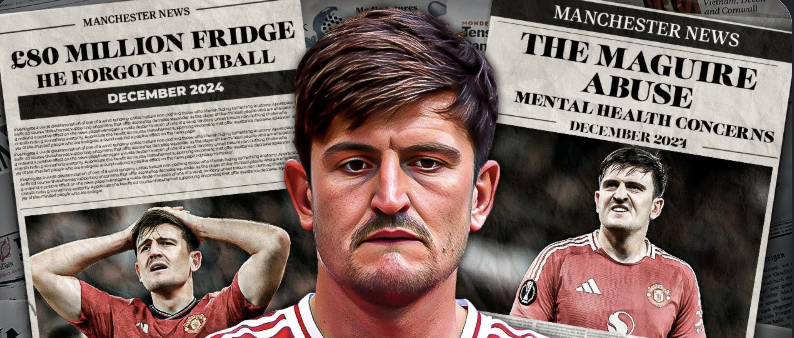
Harry Maguire is one of the clearest examples. From his move to Manchester United until around a year ago, he was dragged across radio, podcasts and print media. The focus moved from analysis to content built to travel, and once a player becomes the trending problem, he stops being assessed and starts being consumed.
The feast is the opposite of the football I described at the start of this article. Football at its best holds a person’s flaws and channels them into growth. The feast takes an opportunity, whether a person’s struggle or the moment they crossed a newly drawn societal boundary on a topic, and consumes it for clicks.
What needs to change
For clubs and governing bodies. Define player care clearly and resource it properly. Pay and position clinicians so they have the power to speak about the invisible injury. Build roles that connect the therapy room to the training ground.
For schools and educators. Use football and movement intentionally as tools for engagement, regulation and learning, not as rewards to be withdrawn or breaks away from work.
For the media. Tell the whole story or wait until you can. Include origins, not just symptoms, and stop the feast.
For parents and men themselves. Recognise what sport has given you, and use it on purpose. A team, a pitch and a coach who pushes you remain some of the most powerful mental health tools available.
Key takeaways
Football has acted as an unintentional mental health intervention for boys who were excluded, displaced or neurodivergent, offering boundaries, community, regulation and acceptance. The EPPP has improved structure but lost agency, and its performance focus means wellbeing often serves the player rather than the person. Player care is poorly understood even by players, and psychologists often lack the pay and power to convey the invisible injury. Mental health reporting focuses on symptoms rather than origins, miseducating the public. The feast turns players' struggles into content, causing real harm.
About Kevin George
Kevin George is a BACP registered psychotherapist, Senior Family Therapist and former professional footballer with West Ham United and Charlton Athletic. For over 20 years he has worked within education across state schools, SEND schools and alternative provision, and has delivered projects in adult prisons and young offender institutions. He supports families through private and community mental health programmes and his private practice in Beckenham and London Victoria, with sessions also available online. He is the Amazon No.1 bestselling author of Soccology, and founder of Soccology CIC.
Work with Kevin
Support for players, academies and clubs. Kevin provides one to one therapy and performance psychology for professional, semi-professional and academy players, alongside psychoeducation for squads and academies, staff training and consultancy, and support for football parents. Built in football’s own language, it works within the culture of the game rather than against it. Explore football services
Therapy for individuals, couples and families. Kevin offers therapy face to face in Beckenham and London Victoria, and online across the UK, plus a check in subscription for consistent support between sessions. Whether you are a player, a former player or someone who found yourself on a pitch when you had nowhere else to go, this is a space built for you. Explore therapy services
Support for schools. Kevin helps schools use sport and movement intentionally for engagement, regulation and wellbeing, with clinical support for pupils, staff and parents. Explore school services
former Manchester United player Paul Pogba linked his depression to his time under José Mourinho. Leeds United’s Dominic Calvert-Lewin said talking saved his life. Former Sheffield United player Christian Nade said he couldn't tell his family why he felt the way he did, because he didn't understand it himself. Each showed real courage, yet in each case the story ended at the symptom or the trigger, and the public learned nothing about where these struggles begin.
Does a player need to share his root cause? No. But those telling the story can provide balance, or choose not to tell it until they can. When the public only ever hears the symptom/symptom focused, the solutions on offer are symptom shaped too.
Improving reporting improves knowledge, strategy, policy and outcomes. Reporting is marketing.
4. The feast
The feast is a term I coined to describe a societal trend. We spot a trending problem and feast on it for our own gain: to increase engagement, to perform empathy and to position ourselves as experts. In the process, the person at the centre of it is severely harmed.
Harry Maguire is one of the clearest examples. From his move to Manchester United until around a year ago, he was dragged across radio, podcasts and print media. The focus moved from analysis to content built to travel, and once a player becomes the trending problem, he stops being assessed and starts being consumed.
The feast is the opposite of the football I described at the start of this article. Football at its best holds a person’s flaws and channels them into growth. The feast takes an opportunity, whether a person’s struggle or the moment they crossed a newly drawn societal boundary on a topic, and consumes it for clicks.
What needs to change
For clubs and governing bodies. Define player care clearly and resource it properly. Pay and position clinicians so they have the power to speak about the invisible injury. Build roles that connect the therapy room to the training ground.
For schools and educators. Use football and movement intentionally as tools for engagement, regulation and learning, not as rewards to be withdrawn or breaks away from work.
For the media. Tell the whole story or wait until you can. Include origins, not just symptoms, and stop the feast.
For parents and men themselves. Recognise what sport has given you, and use it on purpose. A team, a pitch and a coach who pushes you remain some of the most powerful mental health tools available.
Key takeaways
Football has acted as an unintentional mental health intervention for boys who were excluded, displaced or neurodivergent, offering boundaries, community, regulation and acceptance. The EPPP has improved structure but lost agency, and its performance focus means wellbeing often serves the player rather than the person. Player care is poorly understood even by players, and psychologists often lack the pay and power to convey the invisible injury. Mental health reporting focuses on symptoms rather than origins, miseducating the public. The feast turns players' struggles into content, causing real harm.
About Kevin George
Kevin George is a BACP registered psychotherapist, Senior Family Therapist and former professional footballer with West Ham United and Charlton Athletic. For over 20 years he has worked within education across state schools, SEND schools and alternative provision, and has delivered projects in adult prisons and young offender institutions. He supports families through private and community mental health programmes and his private practice in Beckenham and London Victoria, with sessions also available online. He is the Amazon No.1 bestselling author of Soccology, and founder of Soccology CIC.
Work with Kevin
Support for players, academies and clubs. Kevin provides one to one therapy and performance psychology for professional, semi-professional and academy players, alongside psychoeducation for squads and academies, staff training and consultancy, and support for football parents. Built in football’s own language, it works within the culture of the game rather than against it. Explore football services
Therapy for individuals, couples and families. Kevin offers therapy face to face in Beckenham and London Victoria, and online across the UK, plus a check in subscription for consistent support between sessions. Whether you are a player, a former player or someone who found yourself on a pitch when you had nowhere else to go, this is a space built for you. Explore therapy services
Support for schools. Kevin helps schools use sport and movement intentionally for engagement, regulation and wellbeing, with clinical support for pupils, staff and parents. Explore school services
FAQ Frequently asked questions
How does football help men's mental health? Football offers structure, community, physical activity and belonging. For many boys and men, it has also been a place where traits rejected elsewhere, such as aggression and competitiveness, are channelled and rewarded.
Why is football good for boys with ADHD or trauma? Movement supports dopamine regulation, the pitch offers wider boundaries than a classroom, and the risk of being sent off motivates self regulation. Team membership provides belonging and accountability.
What is the EPPP? The Elite Player Performance Plan is the Premier League's youth development framework, introduced in 2012. It sets standards for academies, including coaching, education, welfare and player care.
What is player care in football? Player care is meant to support academy players' wellbeing, life skills and transitions. In practice, understanding of the role varies widely, and some players describe it as closer to a personal assistant role.
Why don't footballers talk about mental health? Fear that exposure will affect their career, a culture of machismo and the absence of clinicians with enough power to advocate for them all play a part.
What is "the feast" in football? The feast is Kevin George's term for the trend of seizing on a player's struggles for engagement, performed empathy or expert positioning, which causes the player real harm.
Can schools use football to improve learning? Yes. Interdisciplinary lessons that use movement, such as measuring jumps in maths, can increase engagement and attainment while supporting self regulation.